Open the template management via:
Navigation bar → Settings → Templates
The template management enables:
The template management covers templates for various data types. Use the tabs above the list to select the relevant data type.
The following data types are available (configuration-dependent):
Samples, Examination packages, Orders, Customers, Recipes, Specifications, Asset, Subasset, Inspection, 8D report, Materials, Batches, Test equipments

Figure: Templates for various data types
The following functions are described using Sample templates as an example.
Sample templates are – unlike other data types – not displayed in a tabular overview but in a hierarchical tree structure. Templates assigned to a parent template are shown indented beneath it. The Plus-/Minus- symbol to the left of a parent template allows subordinate entries to be expanded and collapsed.
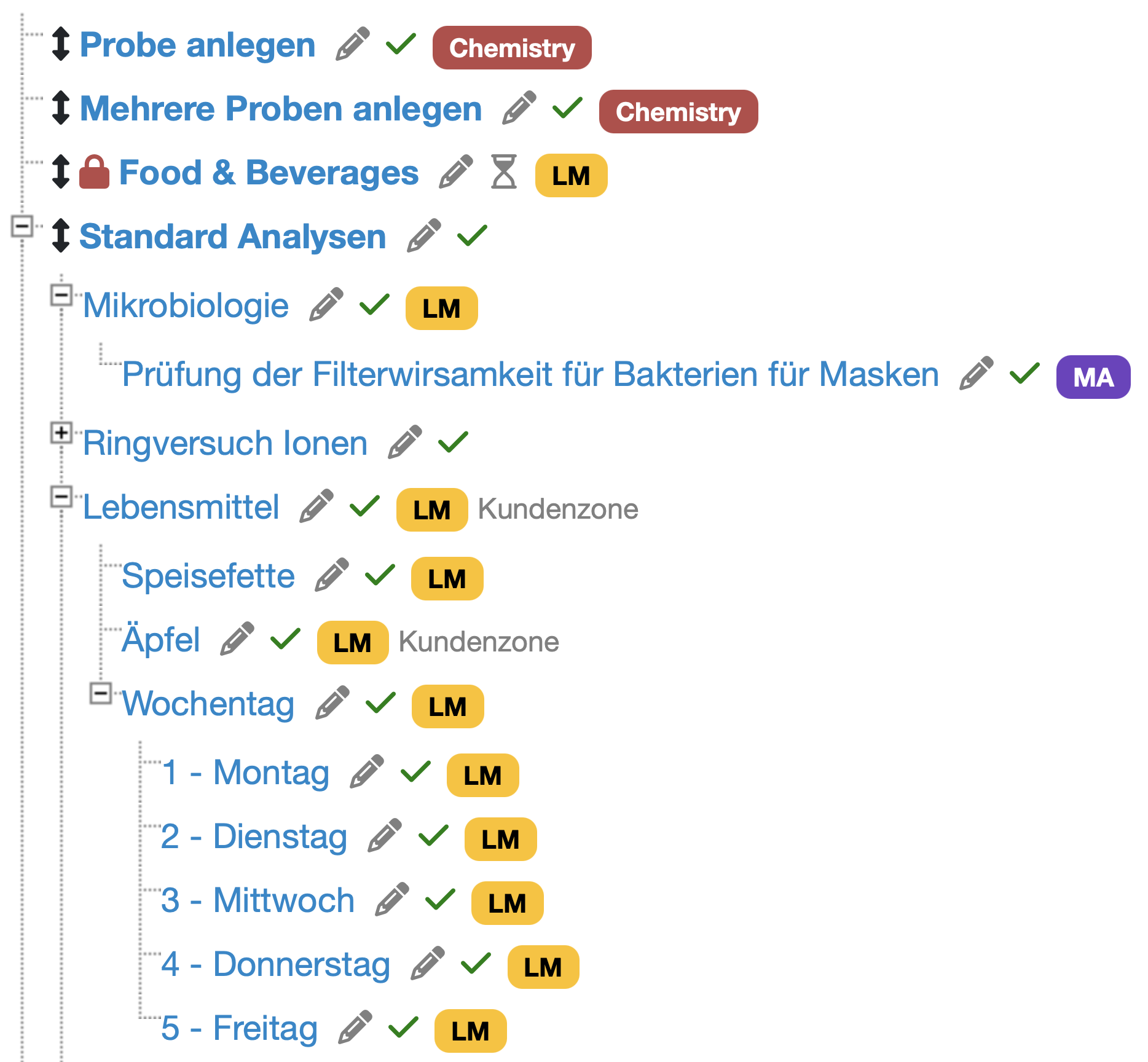
Figure: Tree structure of the Sample template management
Note: All blue highlighted names in the list are clickable links to the respective sample template.
| Element | Description |
|---|---|
| Name | The blue highlighted name of the sample template. A click opens the detail view of the template. |
| Pencil icon | A click opens the editing mask of the sample template directly. |
| Status symbol | Shows the current status of the template. |
| Label/Badge | Colour-coded labels assigned to the sample template. |
| Lock symbol | Indicates that the sample template is not visible to all users (restricted visibility). |
| Sort arrow | Allows repositioning via drag & drop. |
You can then:
Pre-selections in the Sample template
In the sample template, various fields can be pre-filled with default values. These are automatically applied when creating a new sample and do not need to be entered each time. Field names may vary depending on the configuration.
Typical pre-selections include:
Recommendation: Pre-fill as many fields in the sample template as is useful. The more completely a template is configured, the faster and more accurately new samples can be created. Keep in mind, however, that too many templates can increase maintenance effort when changes are required.
After saving the sample template, you can use it to create samples.
For further information: Create/Edit/Add Sample template
Hierarchical structure of Sample templates
The Parent template field is used to organise templates in a structured hierarchy. Sample templates can be subordinated to one another by assigning a parent template. This creates a tree structure: subordinate templates are shown indented beneath their parent template in the list. This structure is also reflected in the navigation menu when creating samples – templates with subordinate entries are marked with an arrow and can be expanded as a submenu. If no parent template is assigned, the template appears as a standalone entry.
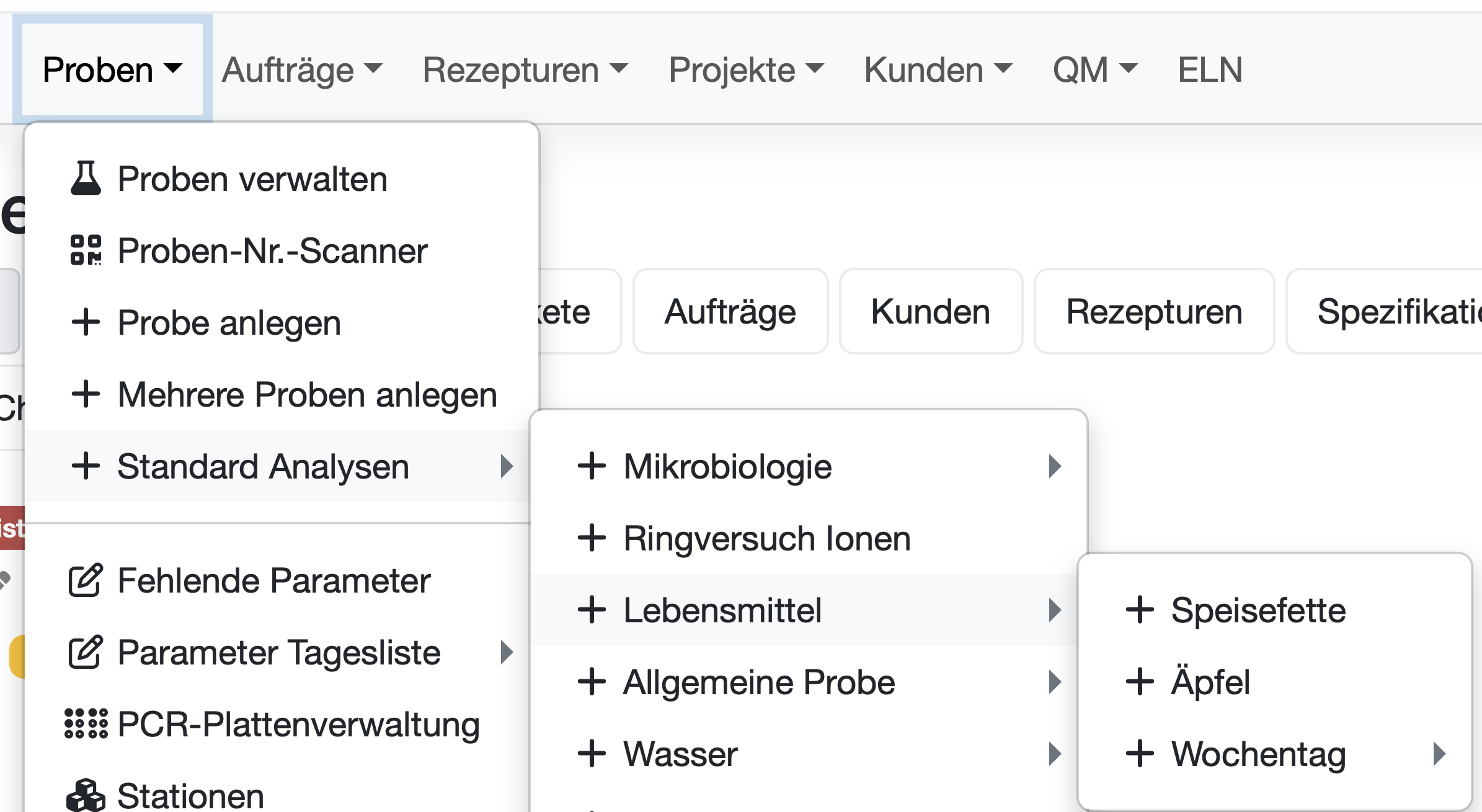
Figure: Structure of Sample templates
The detail view of the sample template displays an overview of the most important information.
Edit the data of an existing sample template using the edit function.
The order of sample templates in the list can be adjusted via drag & drop.
Archived (hidden) sample templates are not visible in the list by default.
Export the sample template master data as an Excel file.
Last change: 08/21/26
General information
Supplier evaluation
Material
Employees
Customers
Orders
Samples
PDF templates
Assets
Recipes
Reports
Report table editor
Interfaces
AI functions
Introductory phase
Query reports
Templates
Client zone (optional)
Offers
Invoices
Parameters
Calculating with parameters
Webservices
Transformationscode
Test plans / limit values / specifications
Documents control
Questions and answers
Equipment
Trainings
8D-report
Others
File management
Processes