Access sample management via:
Navigation bar → Samples → Manage Samples
The sample management allows you to:
The figure shows how the sample management page looks in the LDB. The functions are described below.
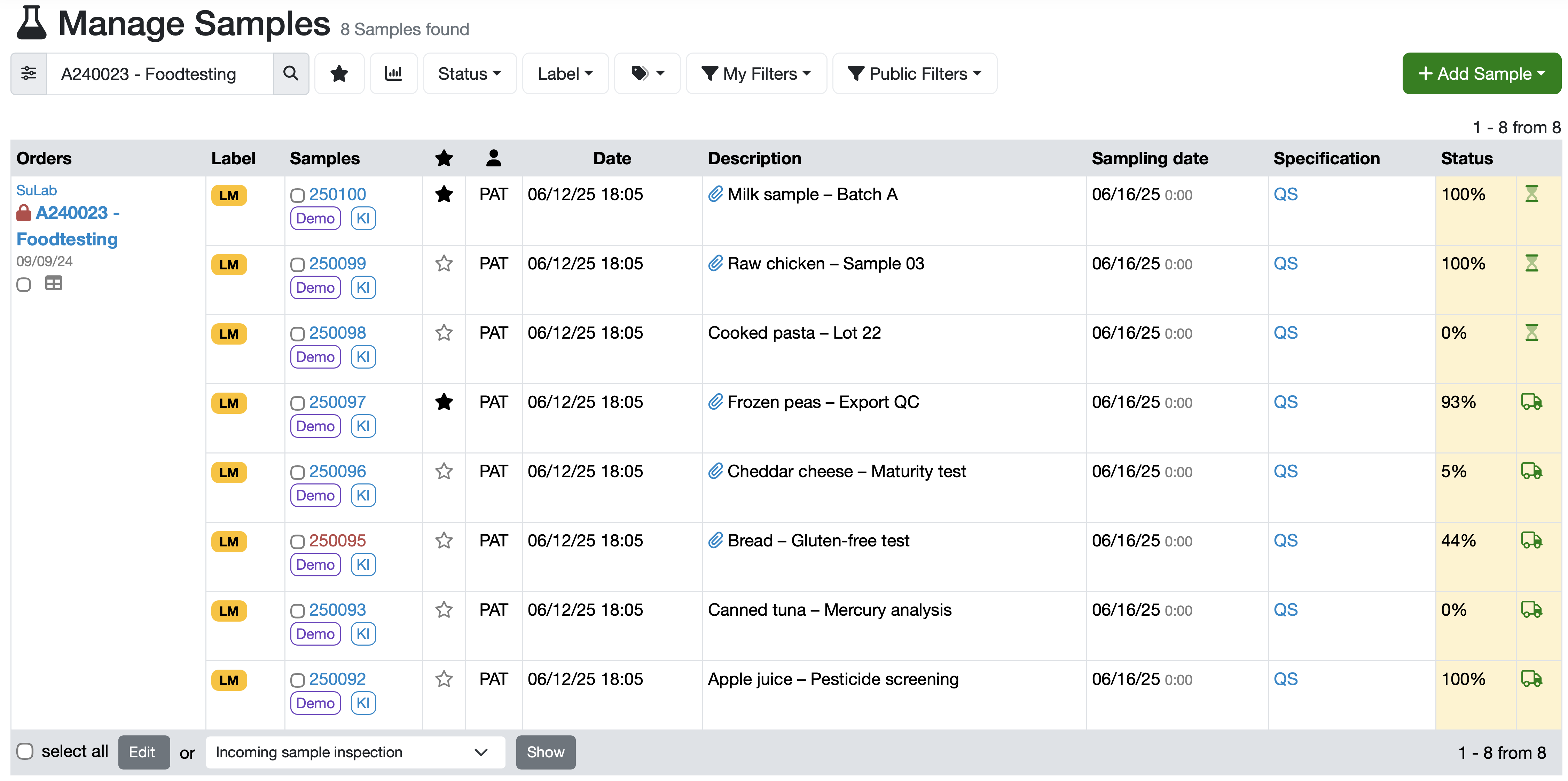
Figure: Sample Management Overview
The samples are displayed in a tabular overview. The following table describes the columns.
Note: All blue texts in the samples list are clickable links to the respective data types (customer, order, sample, related files, etc.).
Some of the columns are always present, others are configuration-dependent. Likewise, the naming of the columns is partly configuration-dependent.
| Column | Description |
|---|---|
| Orders | Shows the order number highlighted in blue along with additional order information. Click the gray table icon to open the samples of the order in the results table. The checkbox enables additional actions described further below. |
| Label | Identifies the label to which the sample is assigned through colored abbreviations. This enables quick visual assignment and can be linked to access and visibility rights. For more information on label access, see: Edit employee group |
| Samples | Contains the sample number highlighted in blue, which takes you to the detailed view of the sample. Samples are displayed grouped by order. There are various options for sorting samples in the sample list, which your customer support team can set up for you. By default, 50 samples are displayed per page. |
| Star symbol | Set favorites by clicking the star symbol to mark a sample as important. |
| Person symbol | Shows the abbreviation of the responsible person or account. |
| Date | Documents the date and time of sample receipt. |
| Description | Provides a descriptive designation of the sample. |
| Sampling date | Is an individually configured master data field that displays the date of sample collection, if recorded. |
| Additional master data | Created by your customer support team and can be displayed in the sample list as needed. |
| Specification | Shows the name of the specification used. |
| Status | Displays the current processing progress of the sample as a percentage along with a colored symbol for quick status recognition. |
Create a new sample directly via sample management.
Modify the data of an already recorded sample via the edit function.
Open the complete detailed view of a sample to view all associated information.
To select samples and make them available for further actions, you have the following options:
Edit multiple samples simultaneously to change master data efficiently and consistently.
Execute predefined actions on selected samples, such as label printing or data export.
Examples of configuration-dependent sample actions:
Various search options are available to find samples quickly and precisely - from simple quick search to detailed filtering.
Quick search
Quick search enables you to search across data types in the LDB without having to switch to the respective area first.

Note: The quick search can also be activated at any time using the keyboard by pressing the s or / key.
In the quick search, you have two search modes:
Cross-area search: Entering your search term lists the found entries across all areas (Samples, Orders, Documents, Processes, Offers, etc.).
Example: Entering Testing displays the Samples, Orders, Documents, Processes, Offers ... that are found for this term.
Search shortcut system: By entering special search shortcuts following the pattern Area:SearchTerm, you can search specifically for samples, customers and other data.
Example: Entering samples:Testing lists only the samples associated with the term Testing.
Click on / or ? to display an info box showing all available search shortcuts and links to searches within the data types.
You can use either the first letter of the search shortcut, e.g. s:123 for samples, or the full search shortcuts such as samples:123 or customers:123.
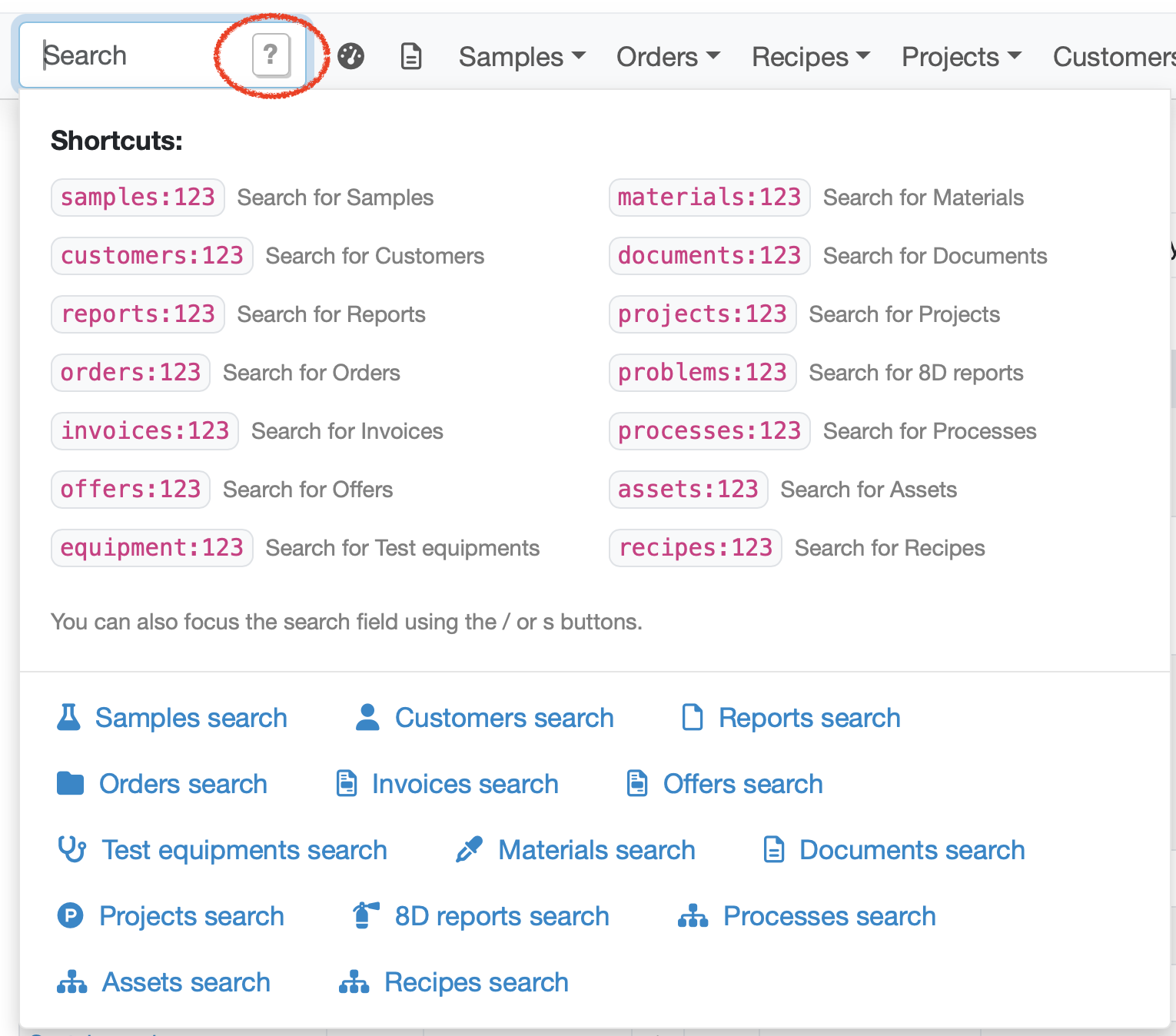
Figure: Search shortcut info box
Simple search
Advanced search / Detailed search
With the detailed search mask, you can filter samples based on specific criteria and combinations, e.g. by Date, Customer, Order, Responsibility, Status, Tags, Reports, Attachments or specific parameters.
For example, you can find all samples where the parameter Conductivity is selected and the pH value > 4.7.
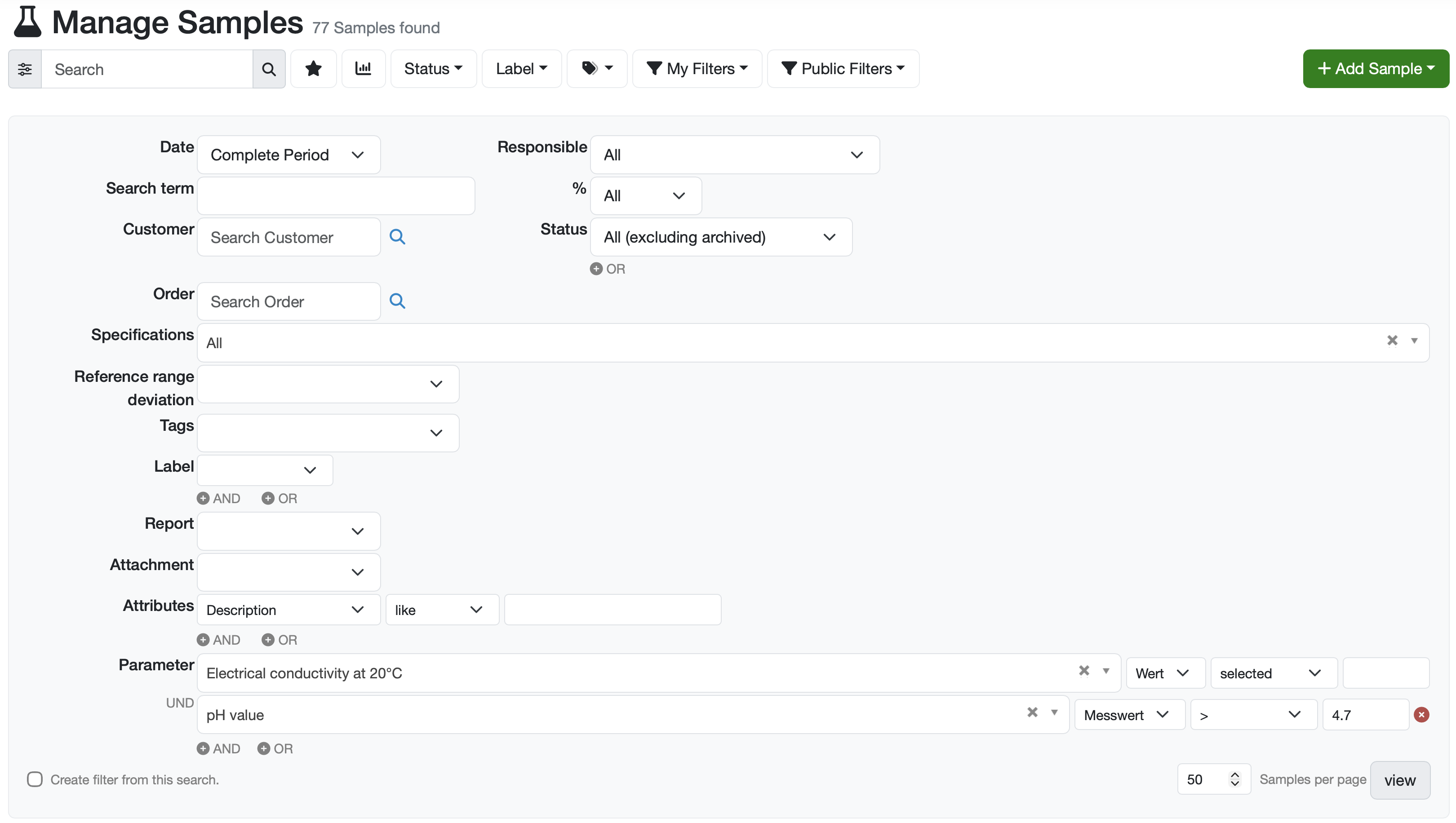
Figure: Advanced search / Detailed search
Info: If you have a link from a scanner and want to search for the sample name, you can use the following link:https://labordatenbank.com/demo/samples/find/SampleName
e.g.: https://labordatenbank.com/demo/samples/find/P-12345
Additional search and filter functions
You can perform common searches using the dropdown menus in the top menu bar above the sample list.
If there are search queries you use repeatedly, you can save them as search filters and access them directly at any time.
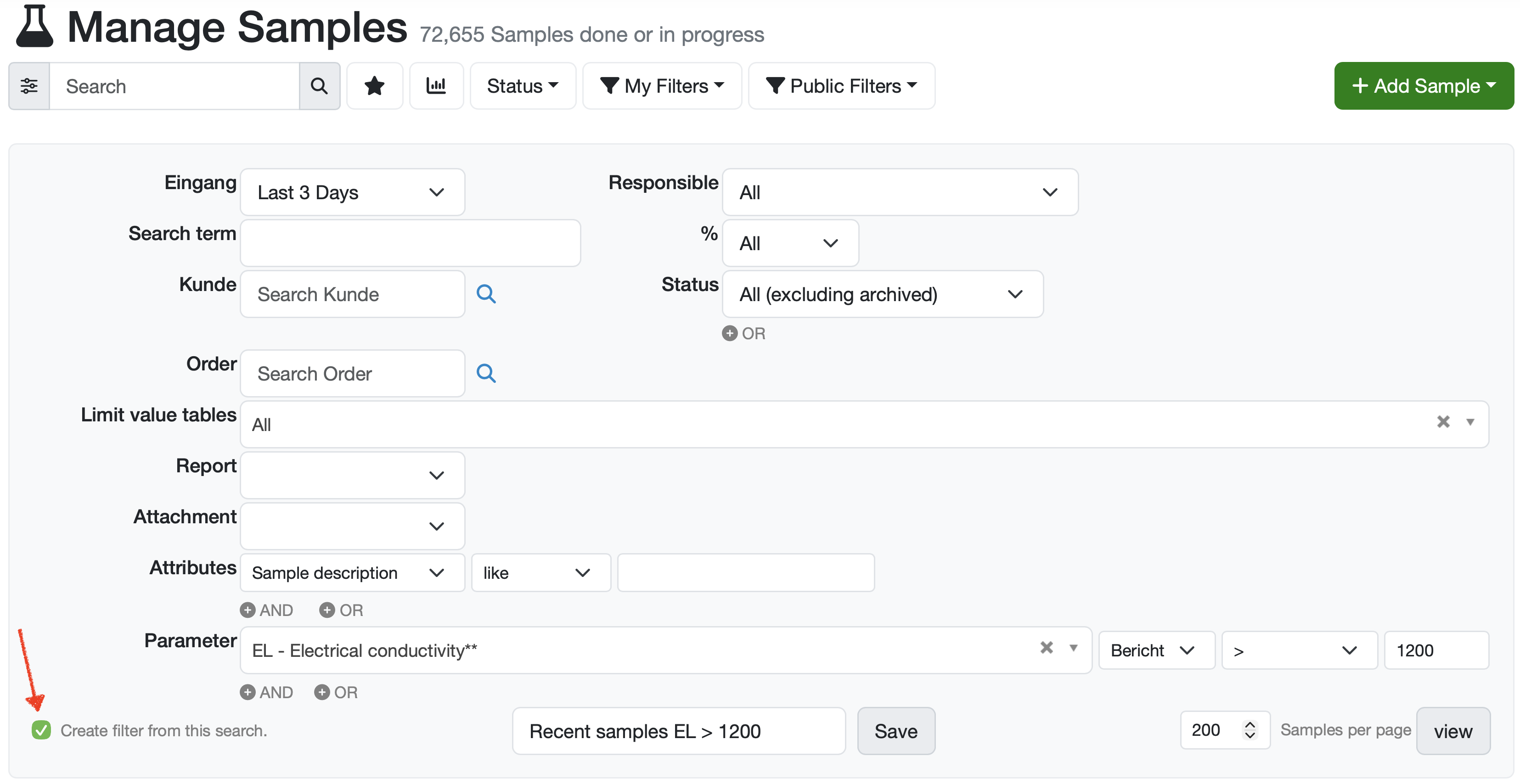
Figure: Save filter
The sample list is divided into pages, with the same number of samples displayed per page. There are various options for sorting samples in the sample list.
Number of samples per page
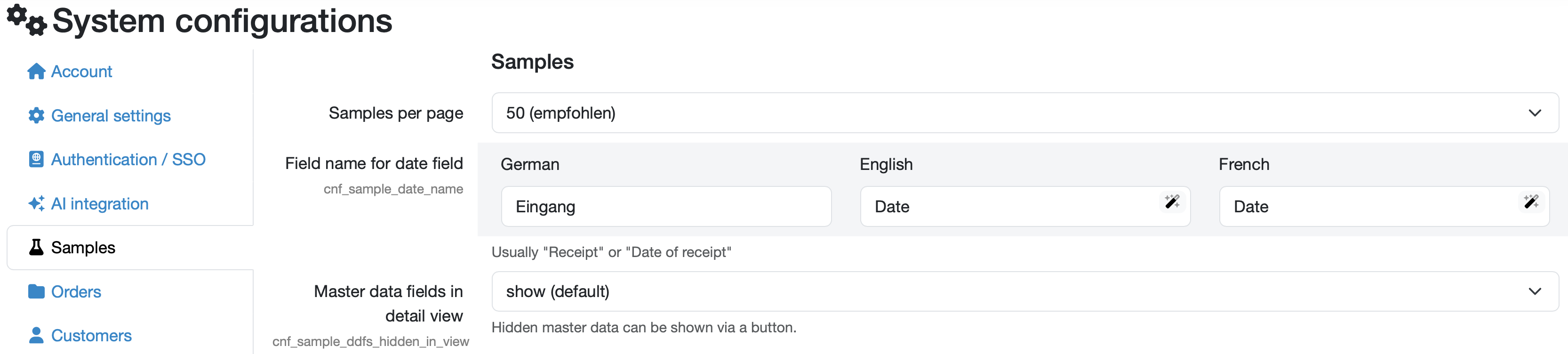
Image: Settings - samples per page
Sorting logic
The sample list is sorted according to the configured sample sorting. Your customer support team can set this up for you.
Example: Descending sorting by sample number or date.
Grouping by orders
If multiple samples belong to an order within a page, they are displayed together under that order. The order is inserted at the position where its highest sample number fits chronologically.

Image: Samples list - Grouping by orders
Display of orders without samples
Orders that fall chronologically between the displayed orders but do not contain any samples from the current page are inserted into the sample list without samples. This ensures a complete chronological overview.
Last change: 08/21/26
General information
Supplier evaluation
Material
Employees
Customers
Orders
Samples
PDF templates
Assets
Recipes
Reports
Report table editor
Interfaces
AI functions
Introductory phase
Query reports
Templates
Client zone (optional)
Offers
Invoices
Parameters
Calculating with parameters
Webservices
Transformationscode
Test plans / limit values / specifications
Documents control
Questions and answers
Equipment
Trainings
8D-report
Others
File management
Processes