In this onboarding video, you will get a compact introduction to parameter management in the LDB:
You can find the parameter management under:
Navigation bar → Settings → Manage parameters.
The functions and structure of parameter management are illustrated and described below:
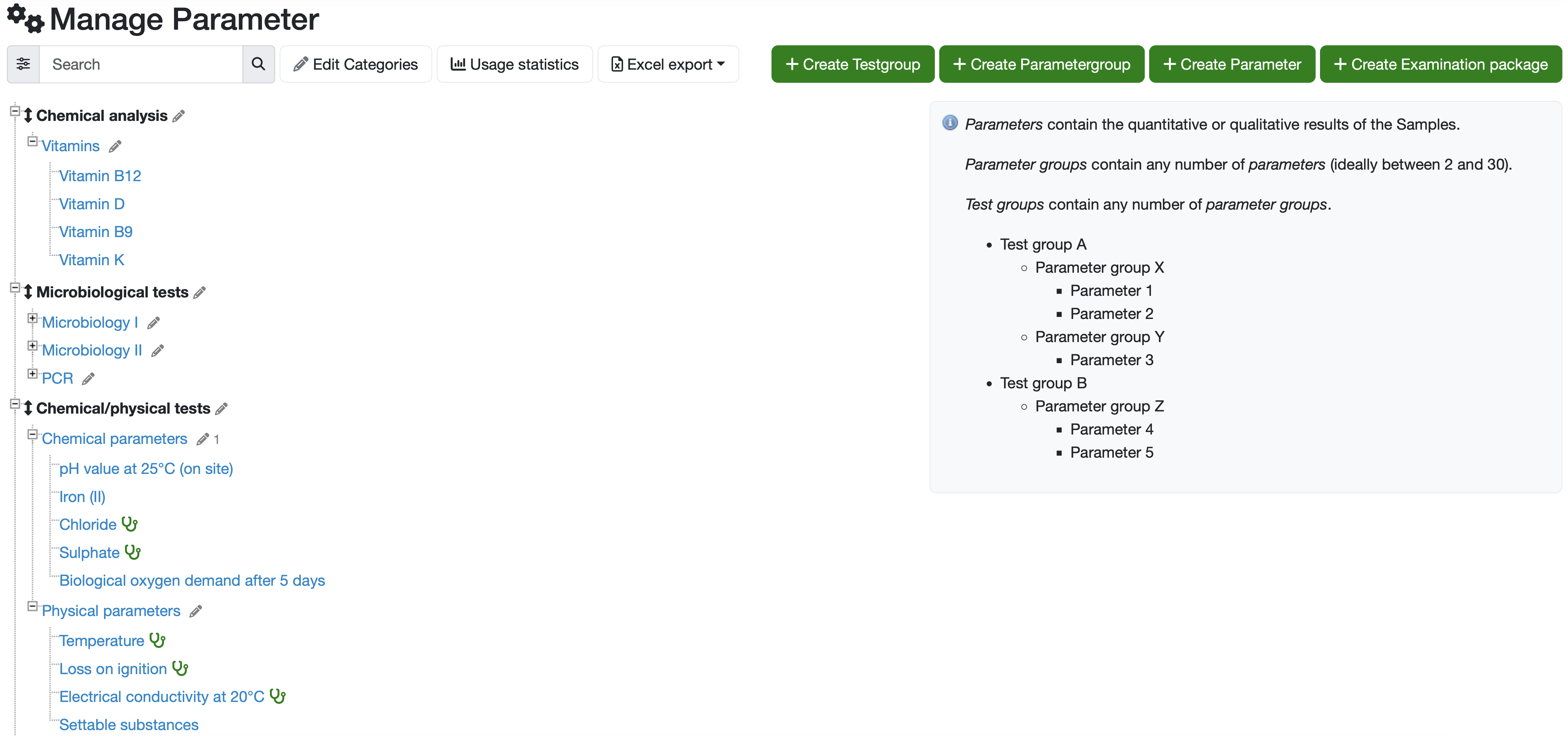
For better orientation and management, parameters in the LDB are organized hierarchically in a tree structure with three levels:
test groups, parameter groups, parameters.
Level 1 - Test groups: The top category level, which groups thematically related tests for the organization of your test areas. They can be grouped by discipline, analysis method, department, subject area, etc. Examples:
Chemical analysis, microbiological tests, chemical/physical tests
Level 2 - Parameter groups: Subgroups within a test group, for further technical structuring to group together thematically related parameters. The optimal number of parameters per parameter group is 2-30. Examples:
Vitamins, Microbiology I, Microbiology II, Chemical parameters, Physical parameters
Level 3 - Parameters: The individual measurement variables and test parameters whose values are determined and entered for a sample. They record the quantitative (numerical values) or qualitative (descriptive) results. Each parameter is clearly named, can be color-coded, has an abbreviation and unit, and can be used specifically in reports and evaluations. Examples:
Vitamin B12, vitamin D, vitamin B9, vitamin K (vitamin parameter group)
pH value at 25°C (on site), iron (II), chloride, sulfate (chemical parameter group)
Temperature, ignition loss, electrical conductivity at 20°C (physical parameter group)
You can expand or collapse test groups and parameter groups by clicking on the box symbols next to the names. When you expand a group, the elements below it become visible.
The order of test groups, parameter groups, and parameters has a **direct influence on the display **and determines the display order of the parameters in the samples and reports.
The order can be sorted using drag-and-drop with the arrow icon in the respective editing view. Any changes are applied immediately and affect all related views (samples, reports, etc.).
The search function allows you to quickly find parameters, parameter groups, or test groups in the LDB. The search is based on names, parameter abbreviations, and parameter formulas.
Use the green buttons in the top menu bar to add new test groups, parameter groups, parameters or test packages.

Further information on creating/editing/deleting can be found at:
Create/edit/delete parameter group
Add/Edit/Delete Parameter
Create/Edit examination packages
The parameter usage statistics provide an overview of the frequency of use of parameters.
For more information, see: Parameter usage statistics
Export the parameters for further processing or documentation.
Further information:
Parameter data types
Deposit formulas with parameters
Calculating with number sequences
Last change: 08/21/26
General information
Supplier evaluation
Material
Employees
Customers
Orders
Samples
PDF templates
Assets
Recipes
Reports
Report table editor
Interfaces
AI functions
Introductory phase
Query reports
Templates
Client zone (optional)
Offers
Invoices
Parameters
Calculating with parameters
Webservices
Transformationscode
Test plans / limit values / specifications
Documents control
Questions and answers
Equipment
Trainings
8D-report
Others
File management
Processes