Objects capture all relevant master data and form the basis for assigning order templates, tapping points and test results.
This guide describes how to create and edit objects for customers in the LDB.
Navigation
To add an object, follow this path:
Navigation bar → Customers → Click on the customer of your choice → Objects → + Add Object
Note: The exact names of the menu items may vary depending on the configuration of your LDB.
Overview
An object enables:
- Recording and managing objects and data related to a customer's objects.
- Assignment of support, type of object, and location information.
- Entry of GIS coordinates for geographic positioning.
- Linking with order templates, inspections, and tapping points.
- Storage of files directly at the object.
Add Object
Note: To add new objects, the customer to which the object will be assigned must be created first.
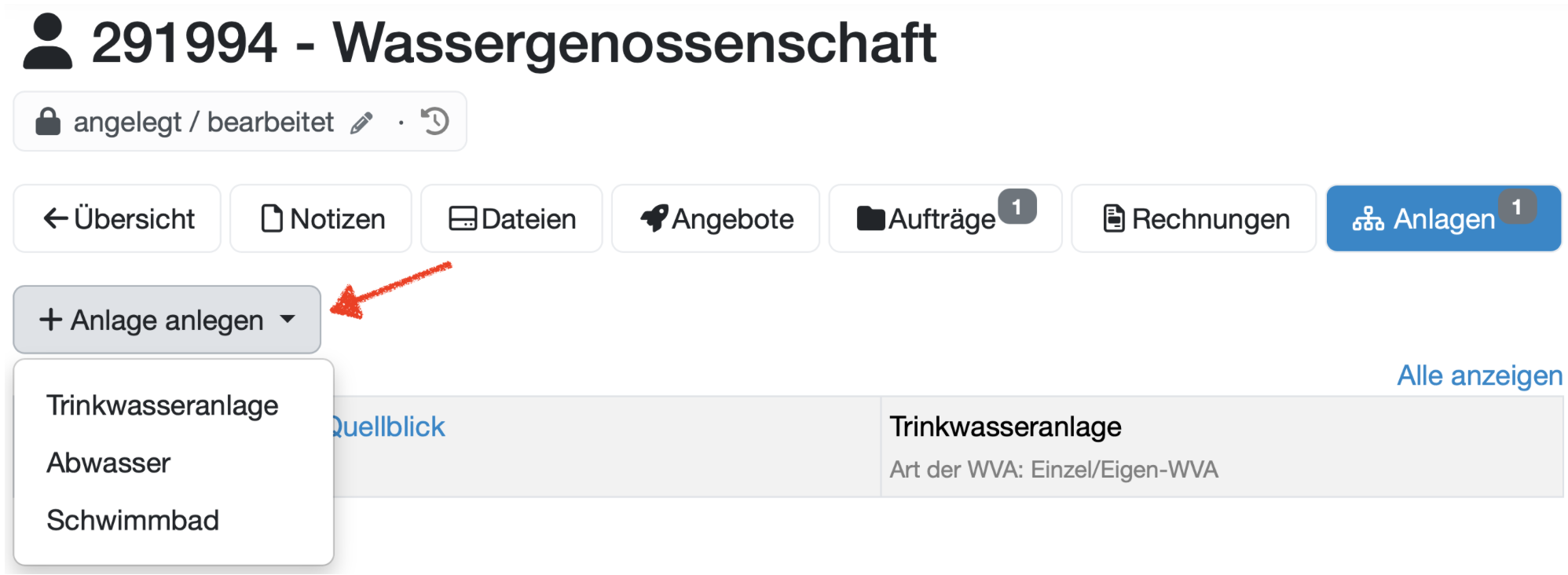
- Click on + Add Object at the customer of your choice.
- Depending on the configuration of your object templates, the stored object types will appear for selection.
Enter Basic Data
The figure shows what the page for adding an object looks like in the LDB. The fields are described below.
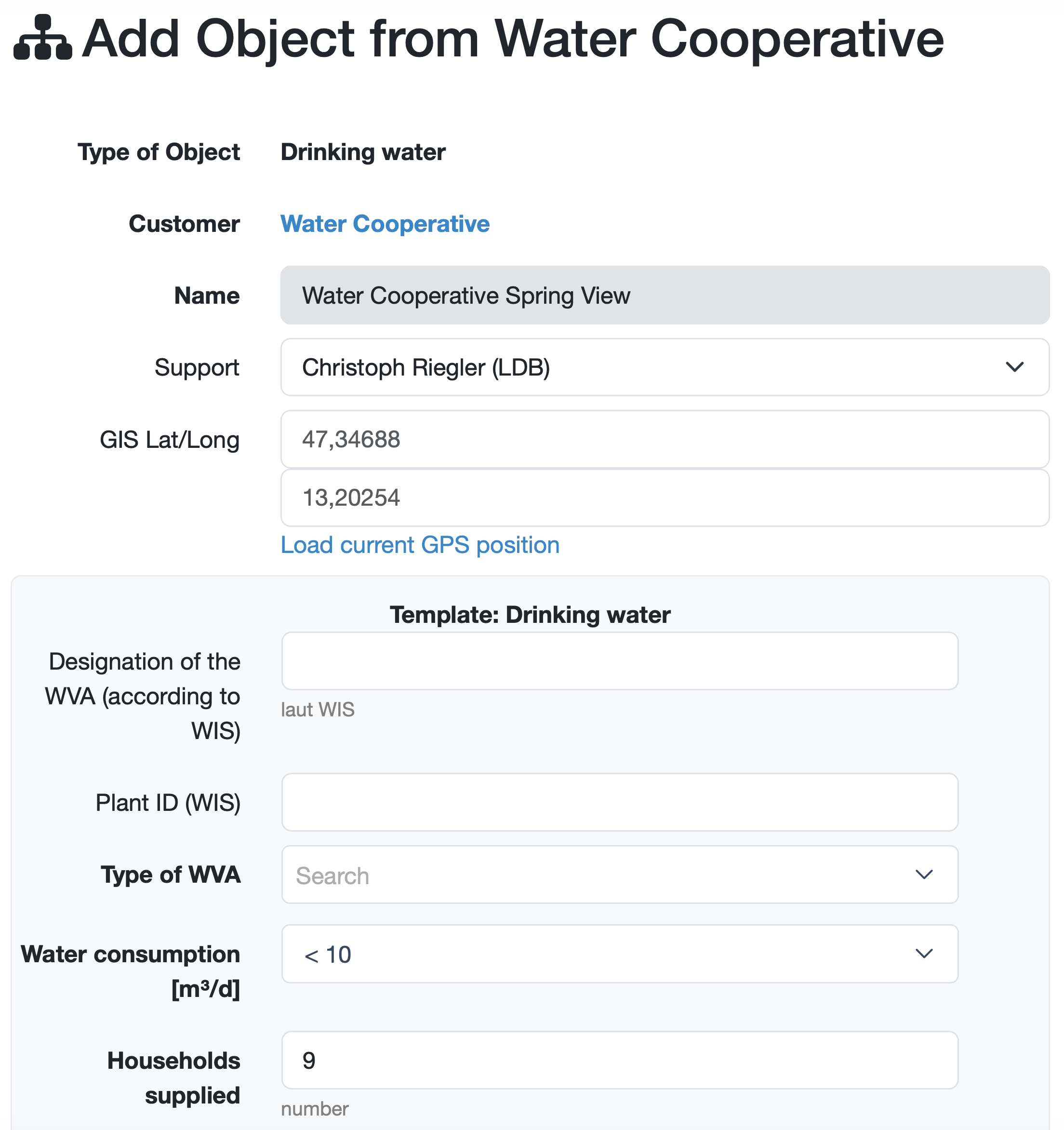
Figure: Add Object
- Type of Object: The type of object is determined by the selected template when adding the object. Depending on the template, the defined fields will appear for completion. The type of object cannot be changed afterwards.
- Customer: The customer is already pre-filled and is displayed as a clickable blue link to the customer detail view.
- Name: Enter a unique name for the object. This field is mandatory.
- Support: Select the responsible support person from the employee management via the dropdown. By default, the currently logged-in person is suggested.
- GIS Lat/Long: Enter the geographic coordinates (latitude and longitude) of the object. Via the link Load current GPS position, the coordinates can be automatically retrieved from the device.
Note: The coordinates are displayed on a map view in the detail view of the object.
Enter Configured Master Data
Depending on the template, additional individually configuration fields are displayed below the basic data. (e.g. Designation of the WVA, Plant ID, Type of WVA, Water consumption [m³/d], Households supplied, ..)
Our recommendation: Fill in the master data as completely as possible. This information will be available later for reports and evaluations.
Planned Orders, Tapping Points and Local Inspections
After saving the object, you can create the associated planned orders, tapping points, and local inspections.
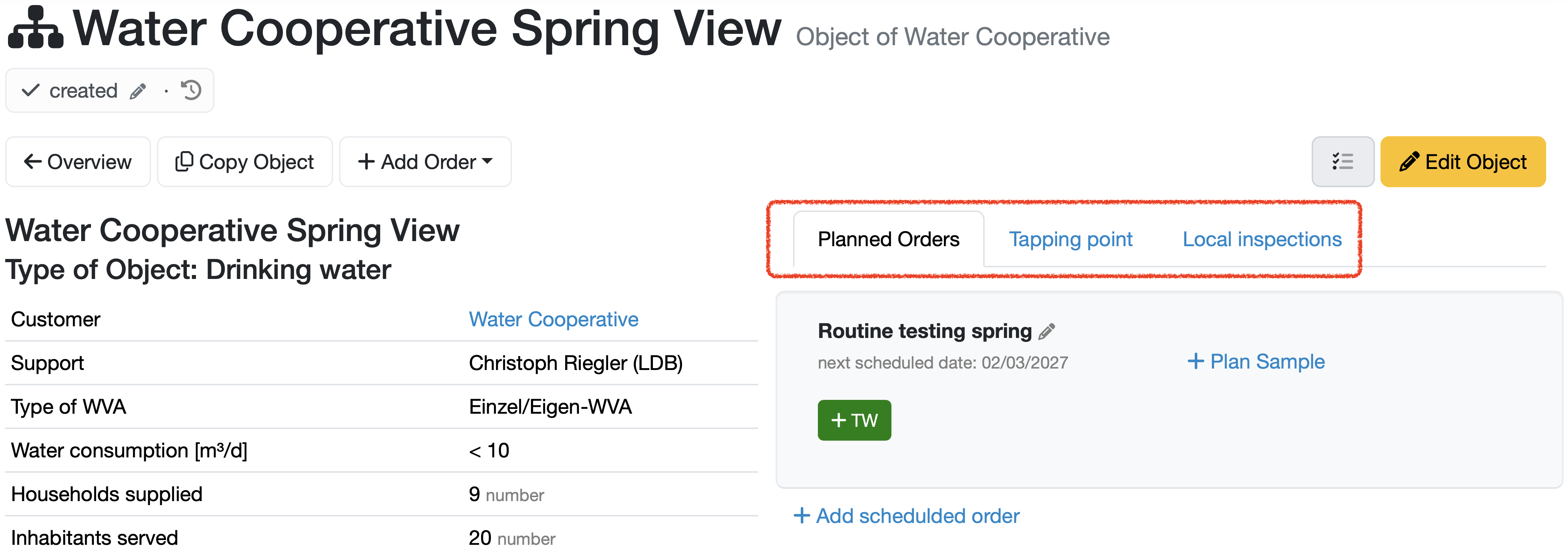
Figure: Planned Orders, Tapping Points and Local Inspections
Further information: LINK_TO_PAGE=Add Order Templates
Edit Object
- Open the object management e.g. under: Navigation bar → Customers → Objects
- Use the search function if needed to find the object more quickly.
- Click on the pencil icon to the right of the object name.
- Alternatively: Click on the blue highlighted object name to open the detail view, then click on the orange button Edit Object.

Figure: Edit Object
Copy Object
- Click on Copy Object in the object management to open the copy mask.
- Alternatively: Click on Copy Object in the detail view of the object to open the copy mask.
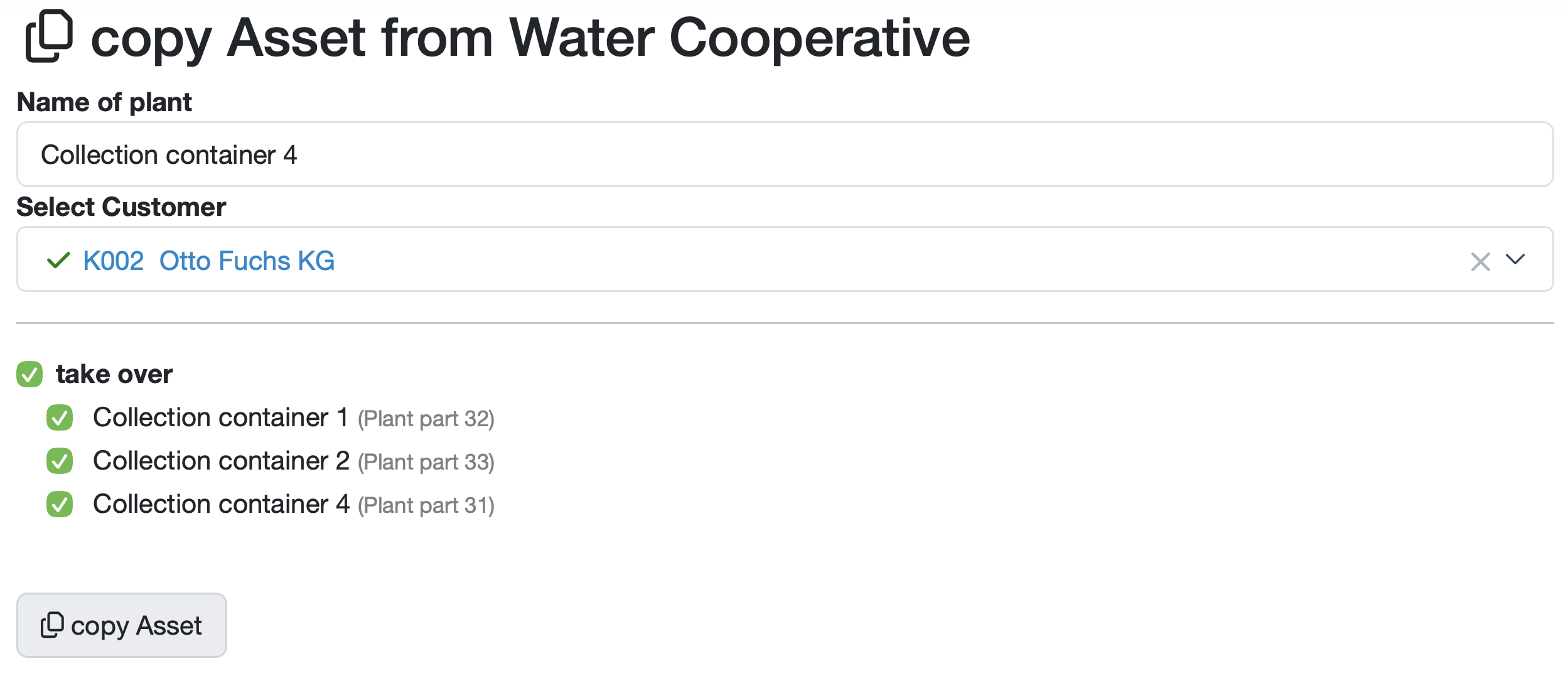
Figure: Copy object
In the copy mask, the following options are available:
- Name of plant: Enter a name for the new object. By default, the name of the original object is pre-filled.
- Select Customer: Use the search field to select the customer to whom this object is assigned.
- take over: Select which tapping points parts are to be taken over into the copy. Individual plant parts can be included or excluded via the checkboxes.
Note: Saved files and inspections are not copied.
Archive Object
Objects that are no longer actively used can be archived.
- Open the editing mask by clicking on Edit Object.
- Change the status of the object to an archived status via the Status field.
Delete Object
An object can only be archived.
Related topics: Equipment GPS location, Add subassets to asset