Add on or more samples with master data and parameters.
Navigation
To add a sample, follow this path:
Navigation bar → Samples → Add Sample
Overview
The sample form allows you to:
- Record sample master data such as description, date, responsible person, and other relevant information
- Assign the sample to an order as well as a label and tags
- Select examination parameters
- Create multiple identical clones of a sample in one step
The fields of the adding / editing sample form are described below:
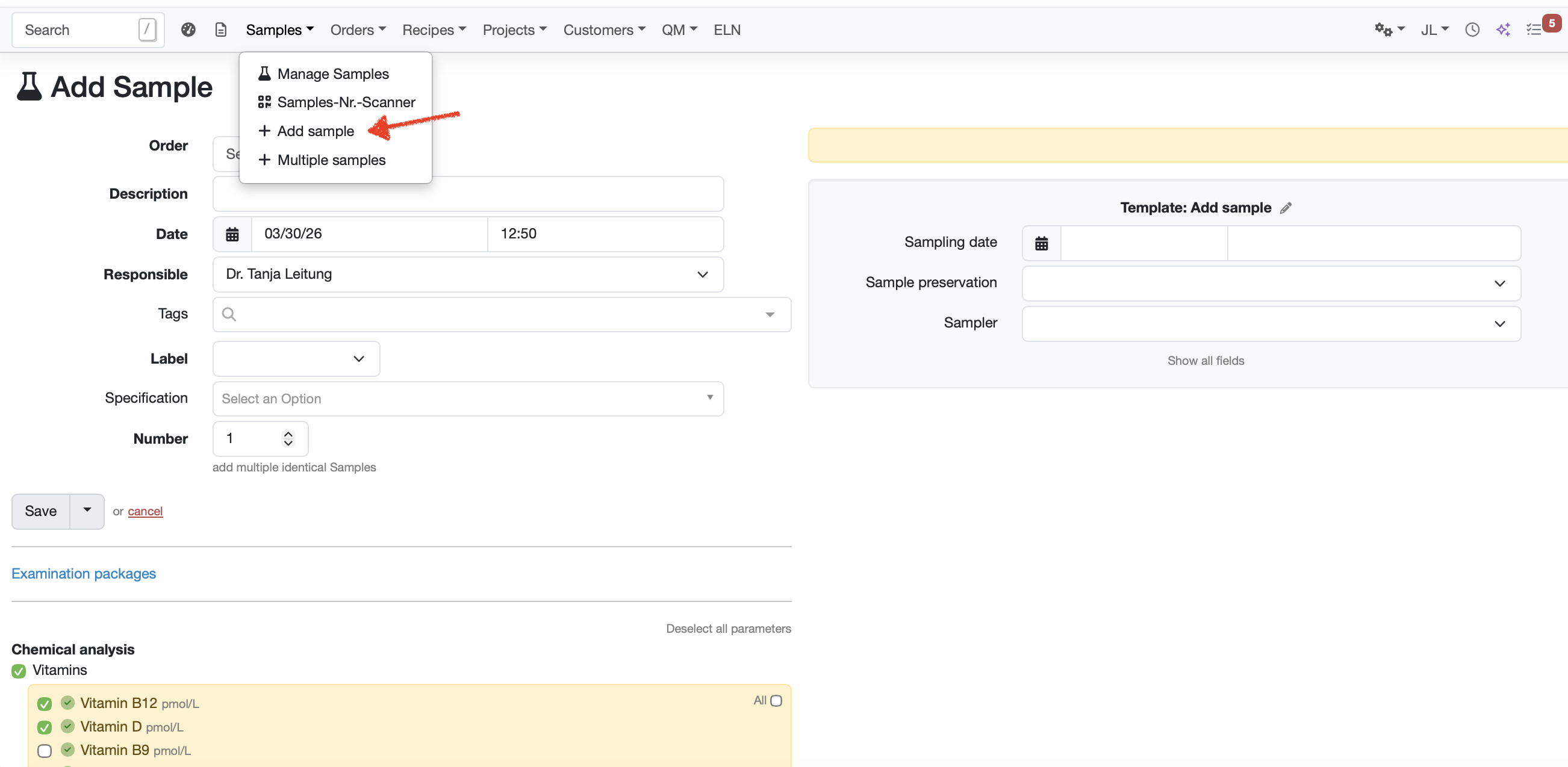
Figure: Add Sample form
Add Sample
Enter basic data (master data, left area)
- Order: Select the order to which the sample should be assigned. Only orders that are neither released nor archived can be selected. Use the magnifying glass icon to search for an order. Use the plus icon to create a new order directly.
- Description: Enter a unique description for the sample.
- Date: Date and time of sample receipt. The current date and time are pre-filled automatically.
- Responsible: Use the dropdown menu to select the person responsible for this sample.
- Tags: Optionally assign tags for better categorization and searchability of the sample.
- Label: Select the label (colored label) to which the sample should be assigned.
- Specification: If needed, select a specification for the sample.
- Number: Enter how many identical clones of this sample should be created. The created clones can be edited individually afterwards.
Enter configured master data (right, grey-highlighted area)
- Configured master data fields (e.g. Sampling date, Sample preservation, Sampler): Enter the data for the sample.
- Template: The currently used template is shown in the upper right. Use the pencil icon to adjust the template. (Required access right: Create / edit templates)
- Show all fields: Click the Show all fields link to display additional configuration-dependent master data fields.
Selecting parameters
In the lower left area of the form, you can define the examination parameters for the sample:
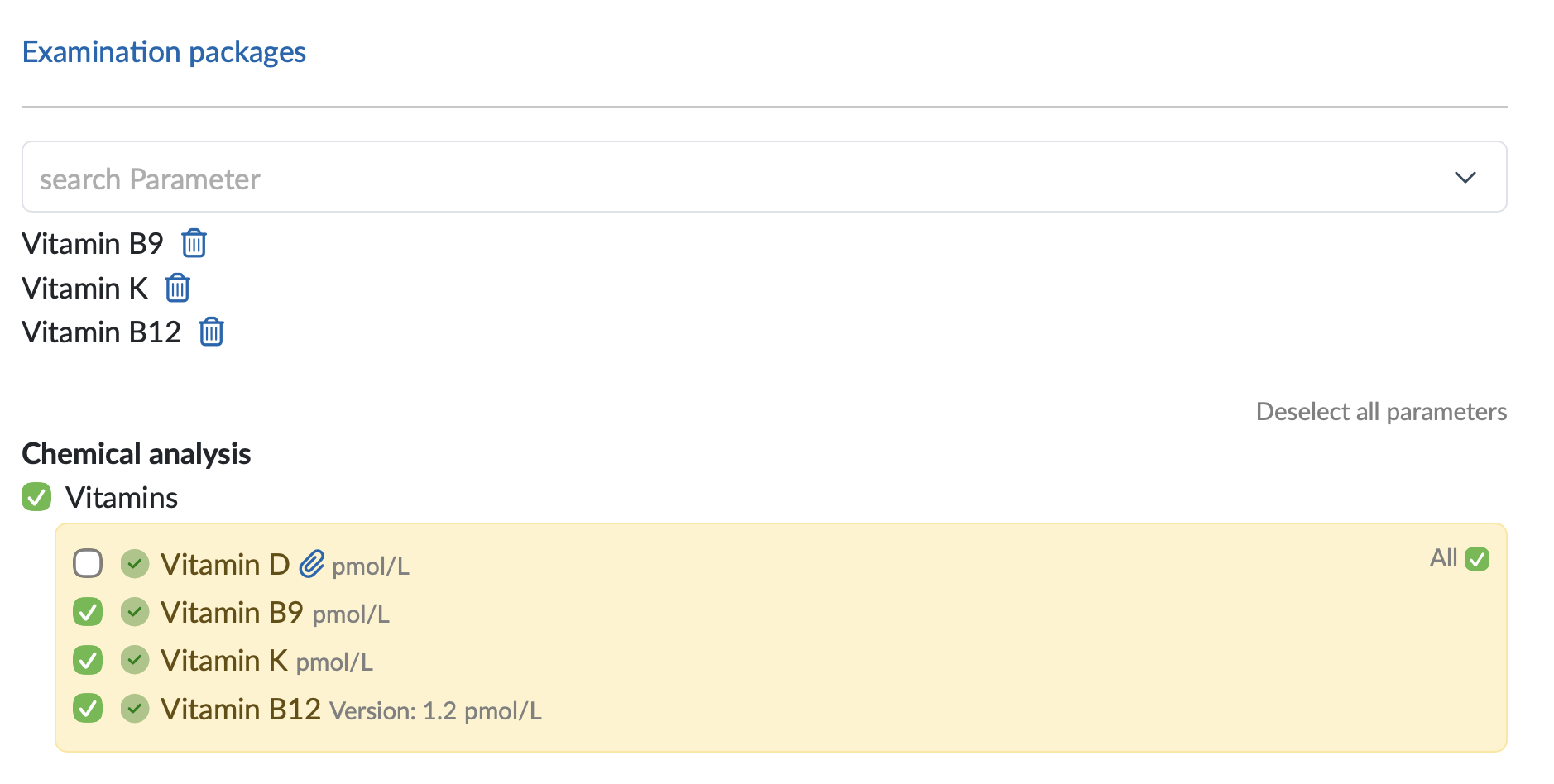
Figure: Parameter selection with search field, examination package and selected parameters
- Parameter selection: Activate the checkbox next to the parameters you want to examine for this sample. Click Deselect all parameters to reset all selections at once. Use the All checkbox within a group to select all parameters of that group at the same time.
- Parameter details: Additional information is displayed next to the parameter name:
- Green check mark icon: indicates the status of the parameter.
- Paper clip icon: a document or attachment is stored for the parameter.
- Version: if a version is stored for the parameter, it is displayed.
- Unit: the unit of the parameter.
Examination packages
Optionally, you can select thematically grouped parameters as examination packages for the sample.
- Selecting a package: Click the blue text Examination packages to expand the list of available packages. Then activate the checkbox next to the package name you want.
- Package parameters: The parameters defined in the package are then automatically selected for the sample and displayed below in the yellow highlighted area. There, you can select or deselect individual parameters using the checkboxes.
Note: Examination packages are an additional, configurable option and are not available by default. Please contact your customer support for activation and configuration.
Searching parameters
Optionally, a search field is available above the parameter selection, allowing you to find specific parameters and add them to the sample.
- Search parameter: Enter the name of a parameter in the search Parameter field, or open the selection list using the arrow on the right. Select the parameter you want to add it to the sample. Parameters that are already selected are greyed out.
- Selected parameters: All currently selected parameters are listed below the search field. This also includes parameters you selected using the checkboxes. Click the trash can icon next to a parameter to remove it from the selection.
Note: The search Parameter function is an additional, configurable option and is not available by default. Please contact your customer support for activation.
Save
After filling in the form, the sample can be saved using the Save button.
Click the arrow next to Save to choose one of the following redirects:
- Save & back to sample list
- Save & back to sample
- Save & back to order
- Save & add another sample
- Save & copy
Note: The default redirect of the Save button is Save & back to sample list.
Your customer support team can change this to Save & back to sample or Save & back to order upon request.
Creating a Sample from a Sample Template
Samples are created on the basis of a sample template. A template can be general-purpose or designed for specific, recurring analyses — already containing the appropriate pre-selections: predefined master data and parameters that are automatically applied when creating a new sample, minimising the data entry effort.
Once a sample template for a recurring analysis has been created, you can use it to create a sample:
-
In the navigation bar, go to Samples and click on the relevant template, e.g. biologische Kleinkläranlage.
-
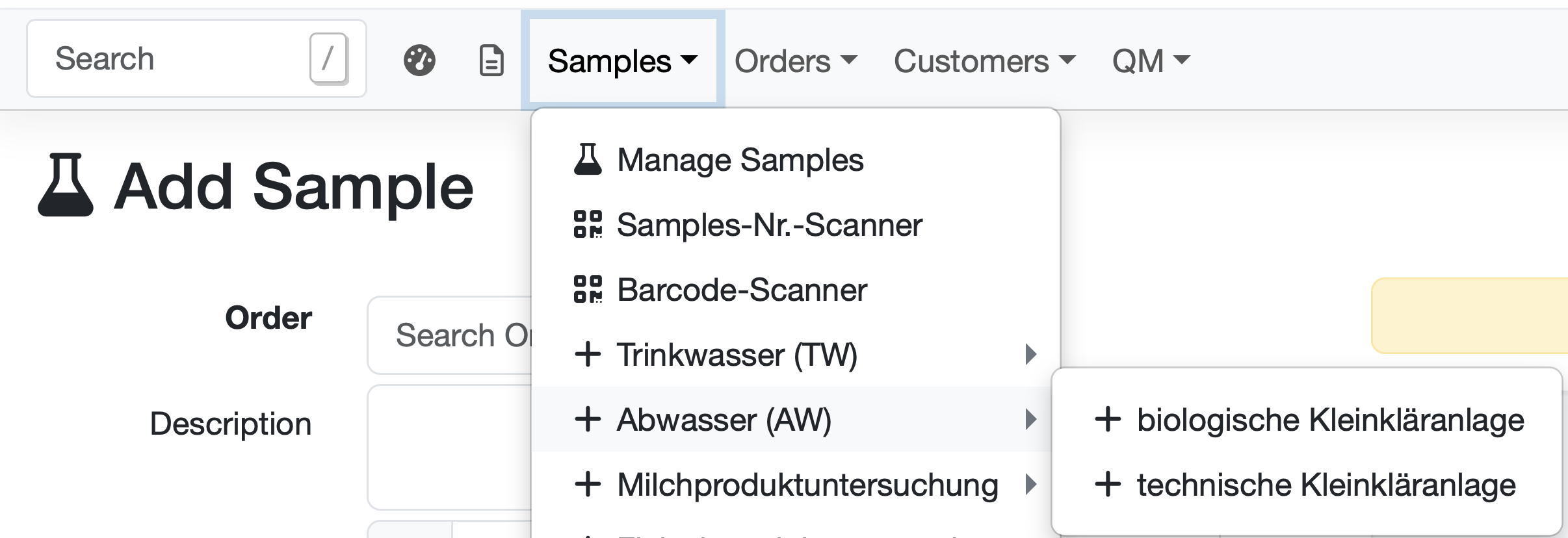
Figure: Selecting a sample template
-
When subsequently creating the sample, you can complete the details for your sample as needed. The already selected and possibly pre-filled master data fields, as well as the selected parameters, correspond to the default selections defined for this sample template. You can add or deselect master data fields or parameters for this sample.
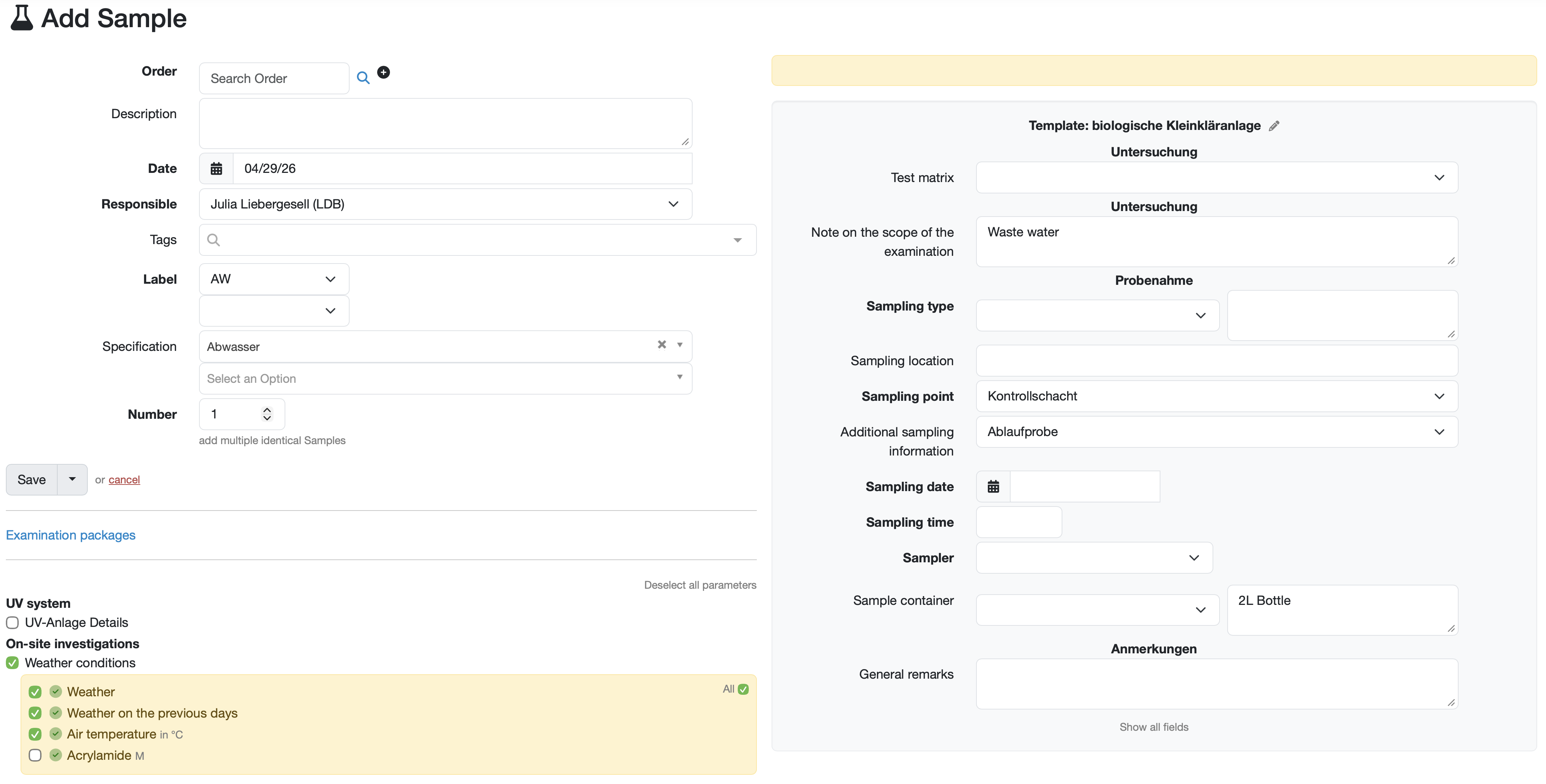
Figure: Creating a sample using a sample template
- Click the Save button to create your sample.
- The sample will now appear in the sample list, where you can enter values or make use of additional functions.
Edit Sample
- Open the sample management under: Navigation bar → Samples → Manage Samples
- Click the blue highlighted name of the sample, then click the orange Edit button.
- Alternatively: Hover the mouse pointer near the blue highlighted name of the sample and click the grey pencil icon.
- Use the search function if needed to find the sample more quickly.
Copy Sample
- In the Edit Sample form, click the arrow next to Save and select Save & copy to adjust the copy afterwards.
- Alternatively: Open the sample management, hover the mouse pointer near the blue highlighted name of the sample, and click the grey copy icon.
Add Multiple Identical Samples
You can create multiple identical samples in one step.
- Select the sample template for adding individual samples.
- Enter the data for your samples.
- Enter the desired number of identical samples in the Number field.
Add Multiple Similar Samples
Add Multiple Different Samples
- Select the sample template for multiple samples.
- Enter the master data that applies to all samples in the upper left area.
- Enter the individual data for each sample in the middle area.
- Additional samples can be added using the green plus button.
- Excess sample rows can be removed using the red minus button.
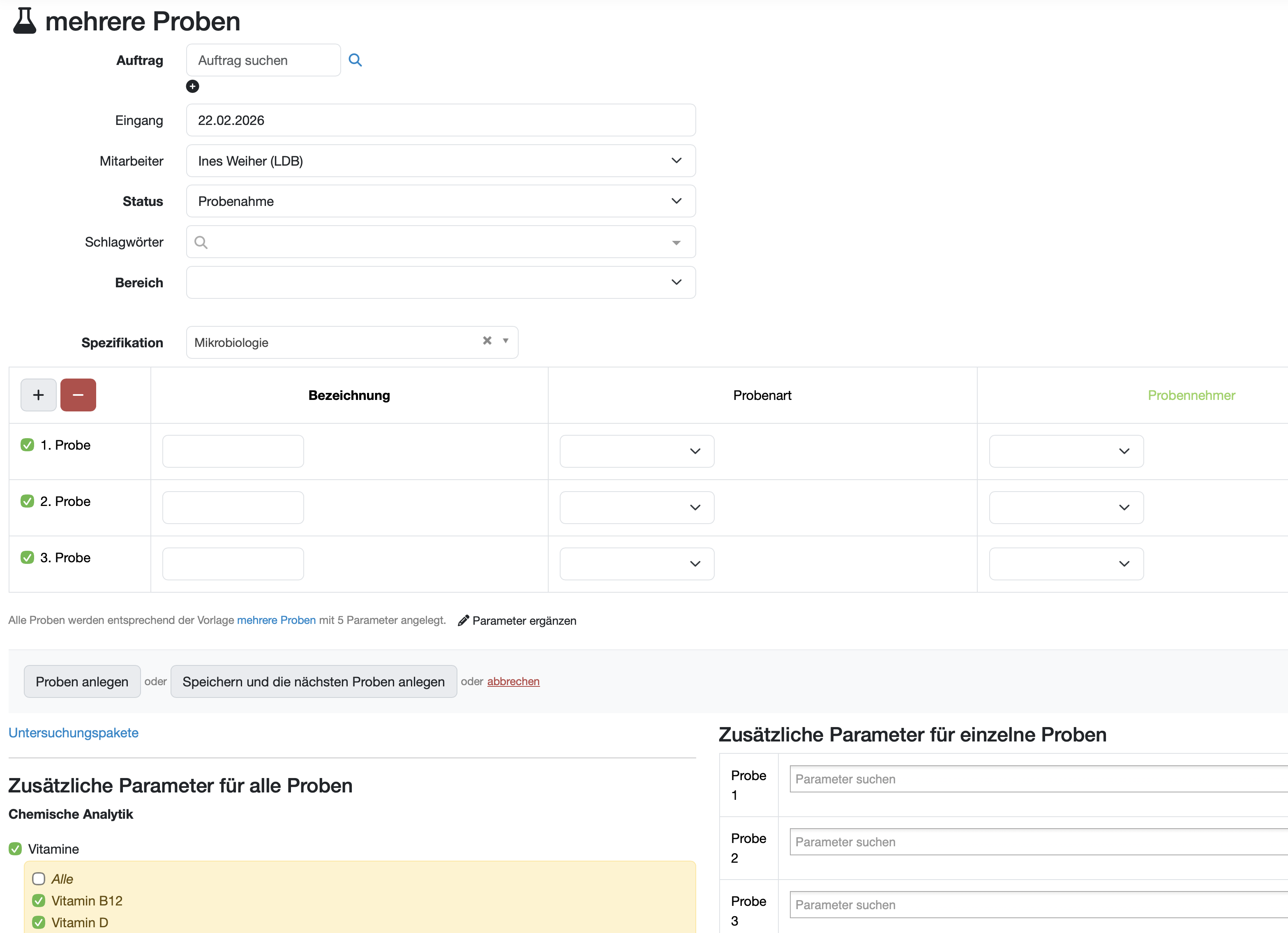
Figure: Form for adding multiple samples
Delete Sample
- In the sample management, click the blue highlighted name of the sample to open the sample detail view.
- Scroll to the bottom of the page and click Delete Sample. (Requires the Delete Sample access right.)
- Deleted data records can be restored via the recycle bin (Navigation bar → Settings → Trash can).
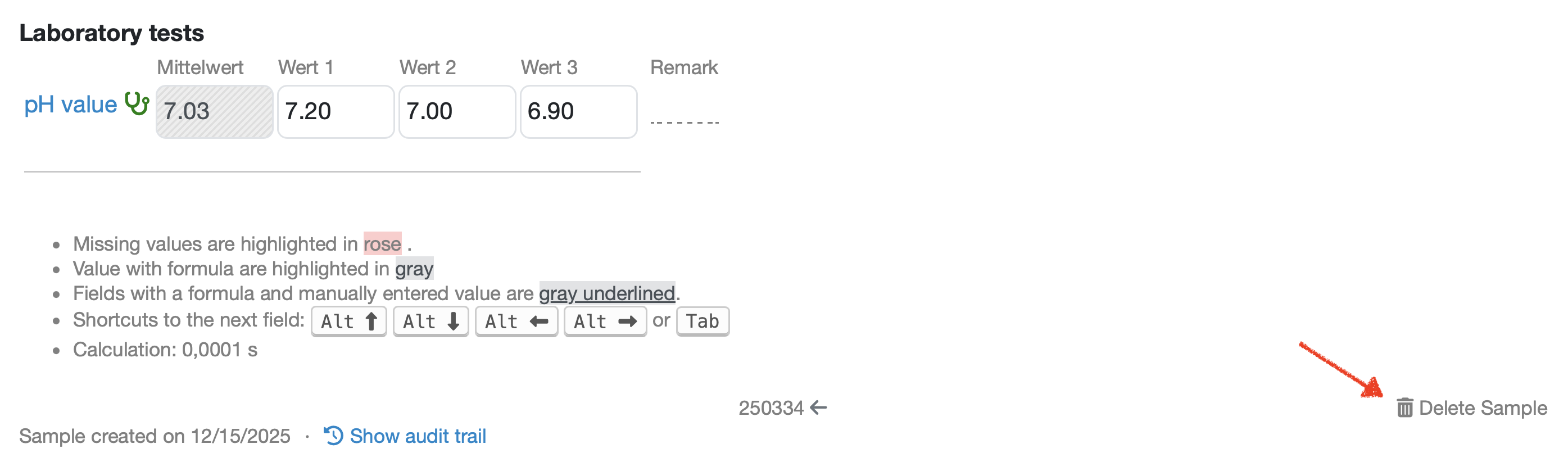
Figure: Delete sample