Add Planned Order and Sample

This guide describes how planned orders and planned samples are created and configured in the LDB.

Navigation

To add a planned order, follow this path:
Navigation bar → Customers → Click on customer of your choice → Objects → Click on object of your choice → Planned Orders → + Add scheduled order

To add a planned sample, follow this path:
Navigation bar → Customers → Click on customer of your choice → Objects → Click on object of your choice → Planned Orders → + Plan Sample

Note: The exact naming of the menu items may vary depending on the configuration of your LDB.


Overview

Planned orders and planned samples can be defined for recurring sampling.
This offers the following advantages:
  • Quick activation – The order can be activated with one click from the order schedule, with all samples already fully prepared.
  • Redundant data entry is avoided – Master data fields can be pre-filled in the planned order / planned sample and are automatically transferred when the order is activated.
  • Schedule automated – Dates are defined once and repeated regularly.
  • Planned samples can be prepared in advance – Sample template, scope of testing, additional parameters and responsible person are stored once.
  • Customer and asset are automatically pre-selected – no manual assignment required.
  • Overview is ensured – All planned orders are clearly visible in the order schedule, structured by year and month, including asset, customer, planned samples and responsible person.

Add a planned order for an object

  • Open the desired object via the detail view.
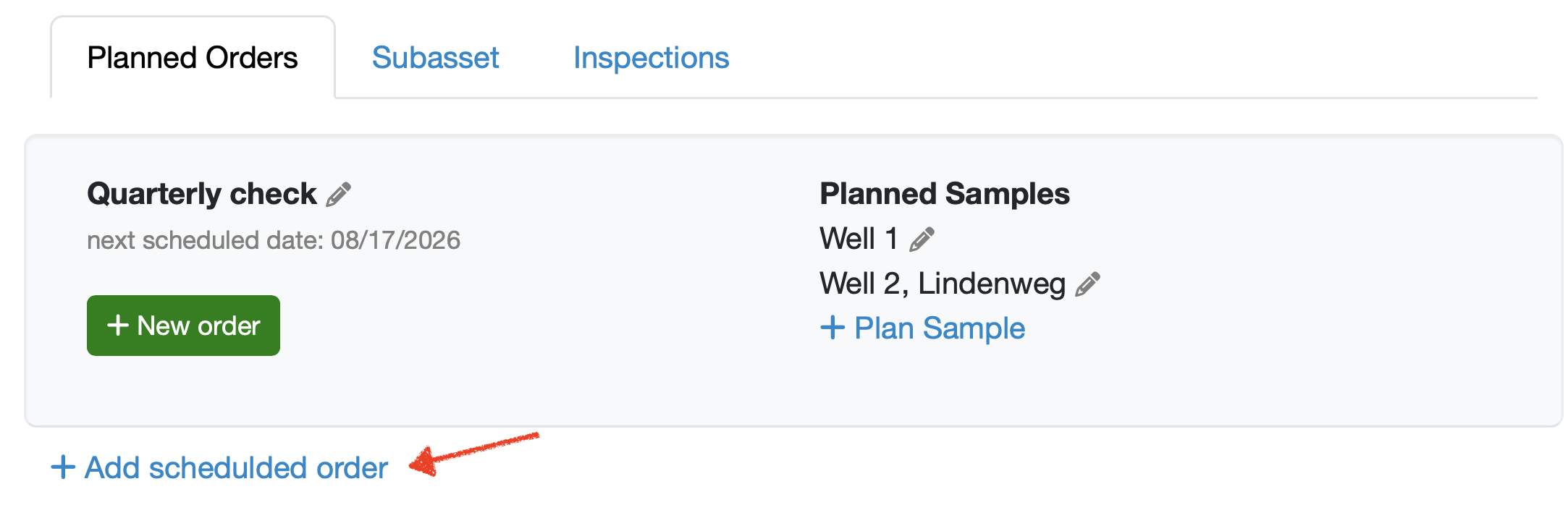
  • Click on the Planned Orders tab on the right, then click + Add scheduled order.

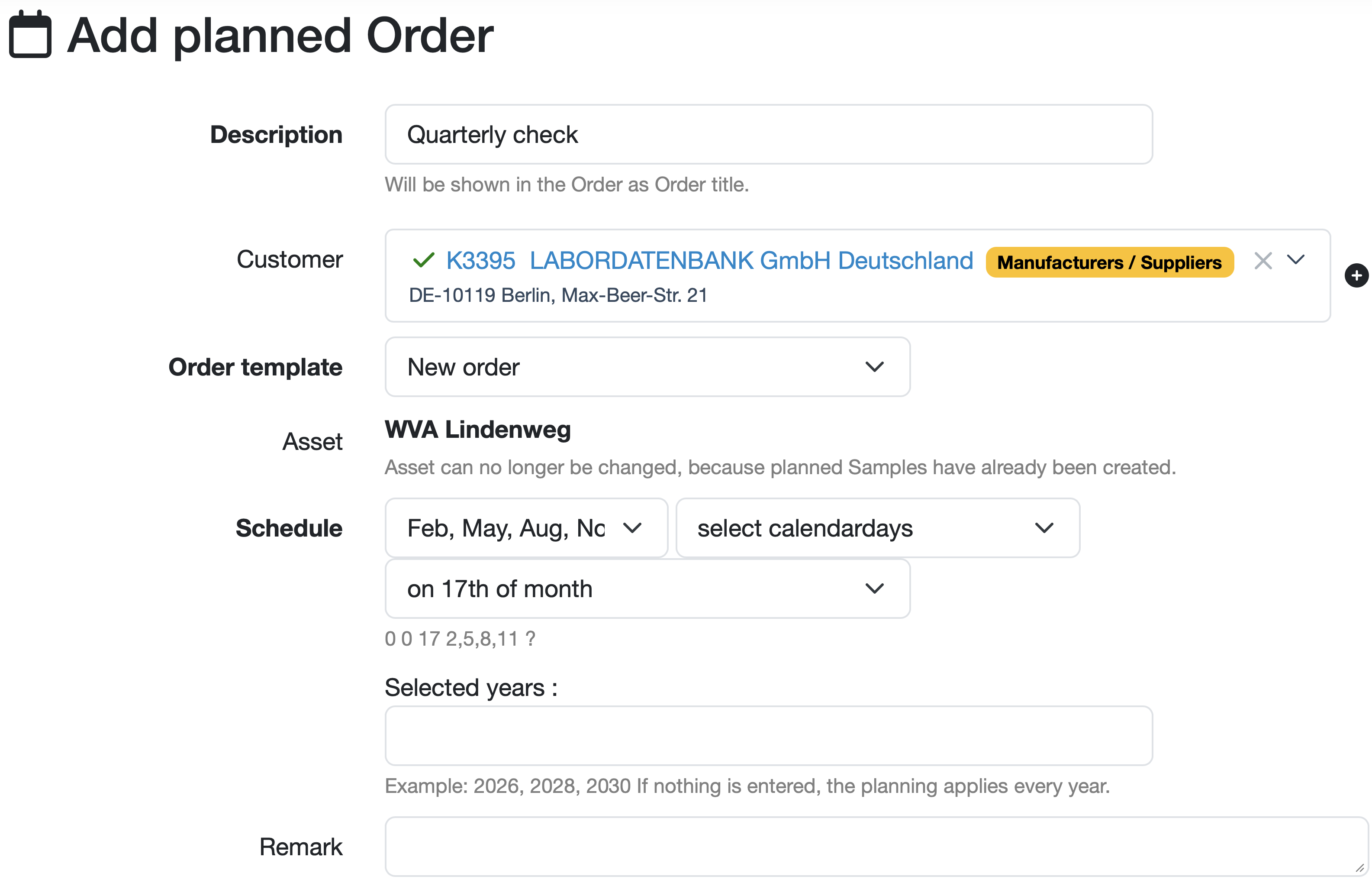
Figure: Add planned order

  • Fill in the form:
    • Description – will be transferred to the order as the order title (e.g. Quarterly check).
    • Order template – select the appropriate template.
    • Asset – is already pre-selected.
    • Schedule – define when the order should be executed.
    • Selected years – optional: Enter individual years (e.g. 2026, 2028, 2030) if the planning should not apply every year. If nothing is entered, the planning applies every year.
    • Remark – optional.

Figure: Add planned order form

The planned order then appears in the order schedule – structured by year and month, with details on asset, customer, planned order, planned samples and responsible person.
In the object, it appears under the Planned Orders tab – including the next scheduled date and the planned samples already stored.
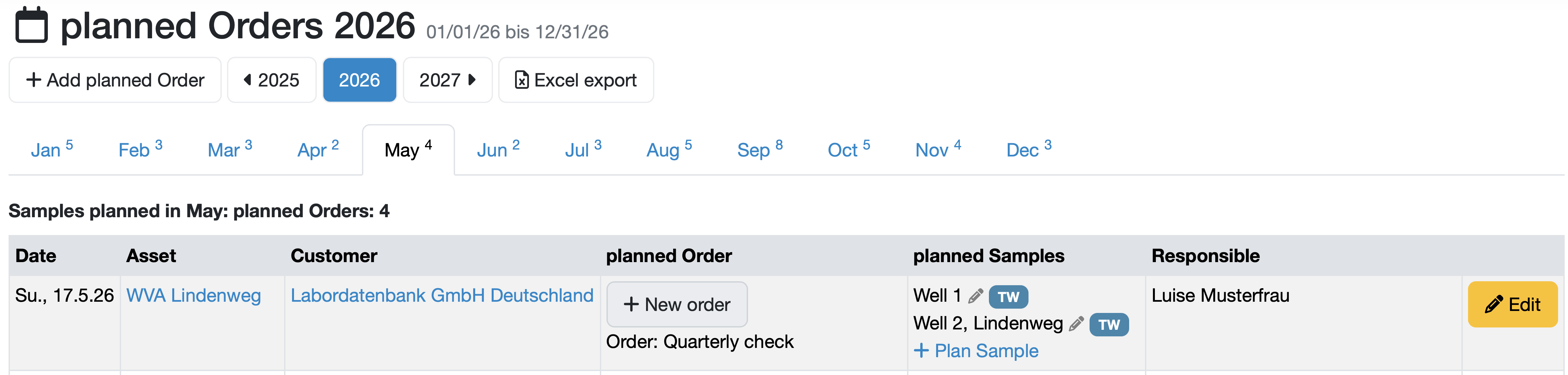
Figure: Planned orders

Add planned samples

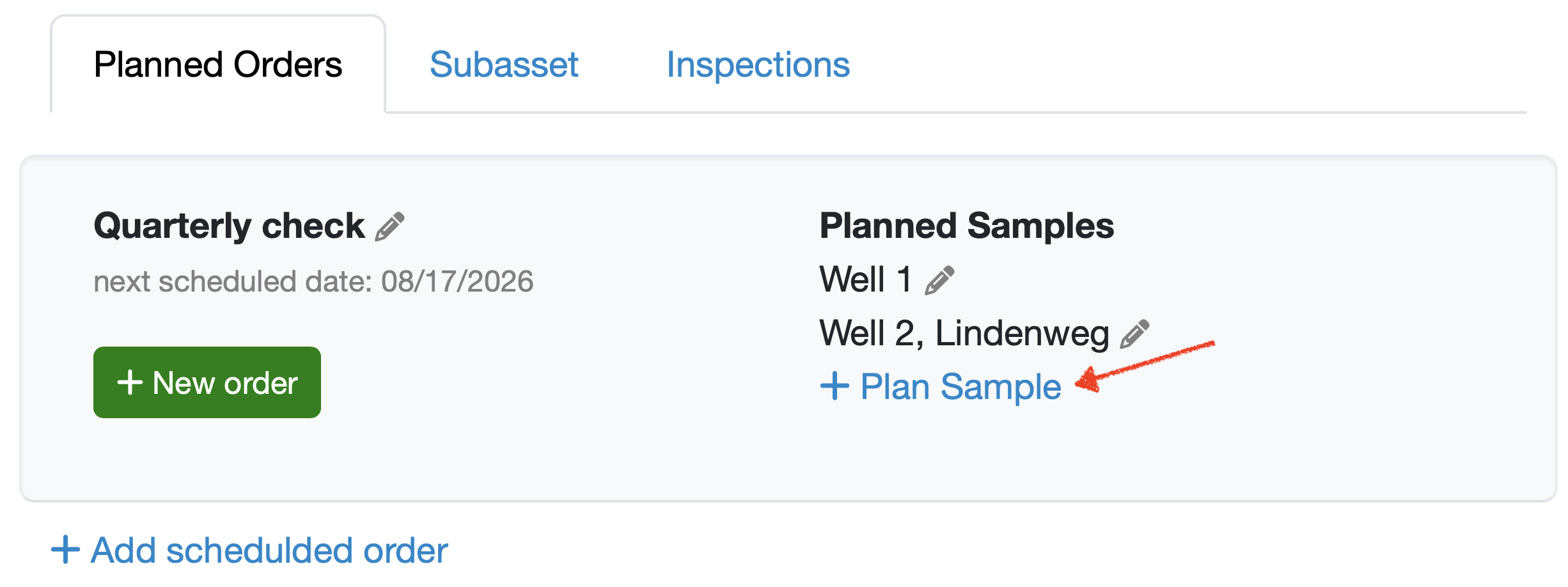
  • Click + Plan Sample in the Planned Orders tab to add planned samples to the order.
  • Alternatively: Click + Plan Sample in the planned Samples column of the relevant order in the order schedule.

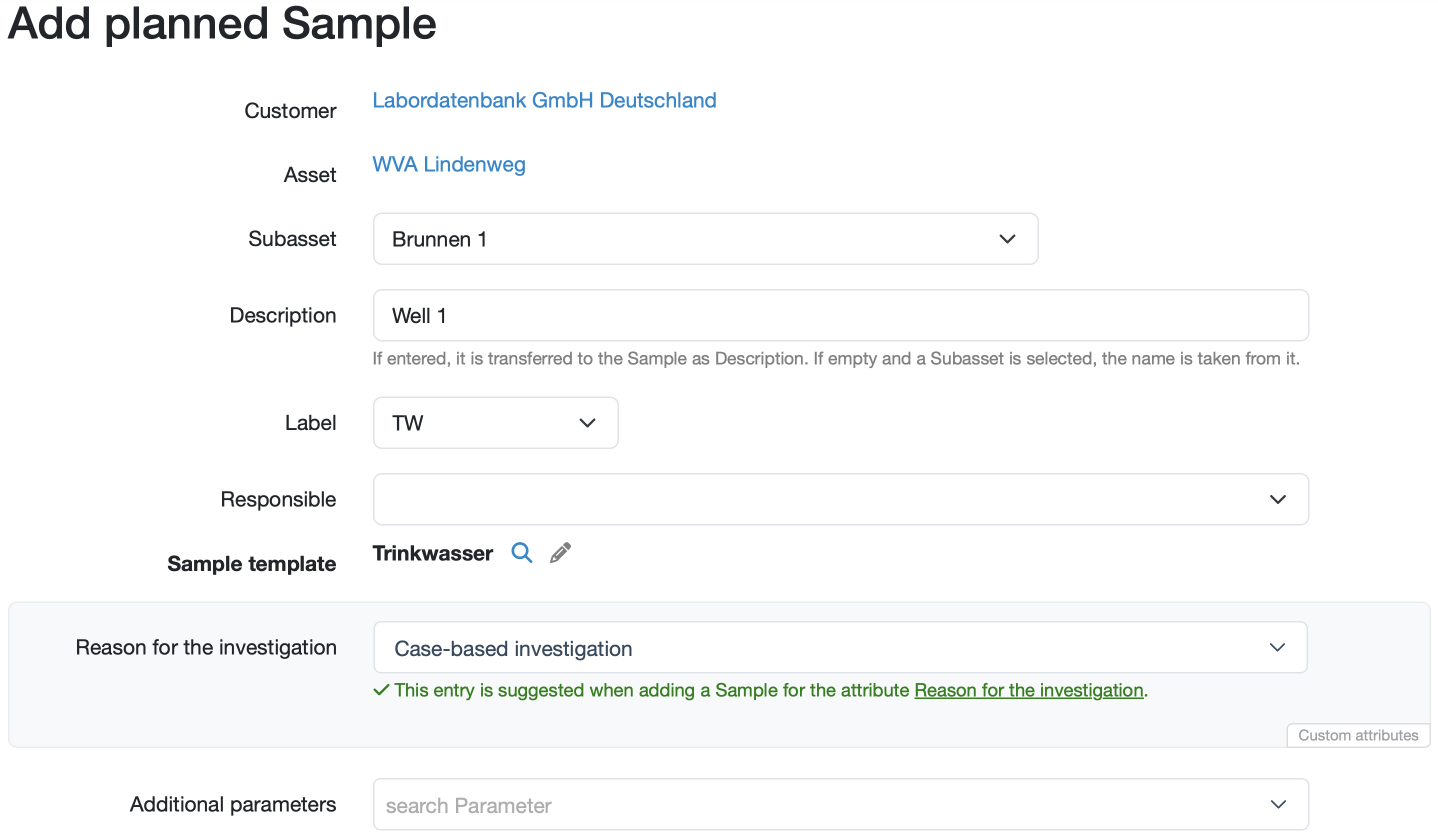
Figure: Add planned sample

  • Fill in the form:
    • Description – optional: Will be transferred to the sample as description. If empty and a subasset is selected, the name is taken from it.
    • Label – optional, for a better overview in the order schedule.
    • Responsible – optional: Assign the sample to a responsible person.
    • Sample template – required: Contains the master data fields and scope of testing (e.g. Drinking water).
    • Custom attributes – Master data fields from the sample template can be pre-filled here (e.g. Reason for the investigation). The entered value is suggested when the sample is later created and does not need to be entered again.
    • Additional parameters – optional: Add sample-specific parameters beyond the standard scope of the template.
  • Click Save or Save and add next entry to immediately add the next planned sample for another subasset.

Figure: Add planned sample form


Activate a planned order

When the scheduled date is reached, the order can be activated.
You have two options:

  • Directly from the order schedule:
    • Click + New order.

Figure: Activate planned order in order schedule
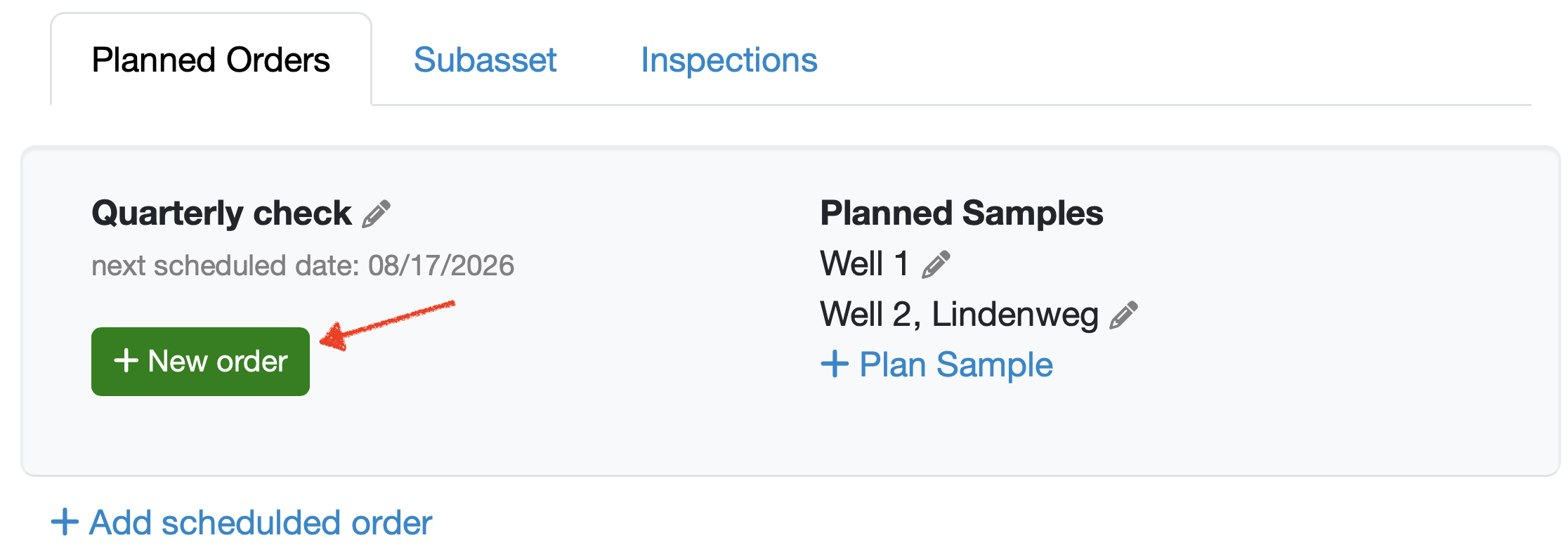
  • From the object:
    • Click + New order.

Figure: Activate planned order in object

The planned samples are already included when the order is activated – including pre-filled master data fields and scopes of testing. You can still decide at this point which samples should actually be included – e.g. if a subasset is currently unavailable. Samples that are not needed can simply be deselected before saving.
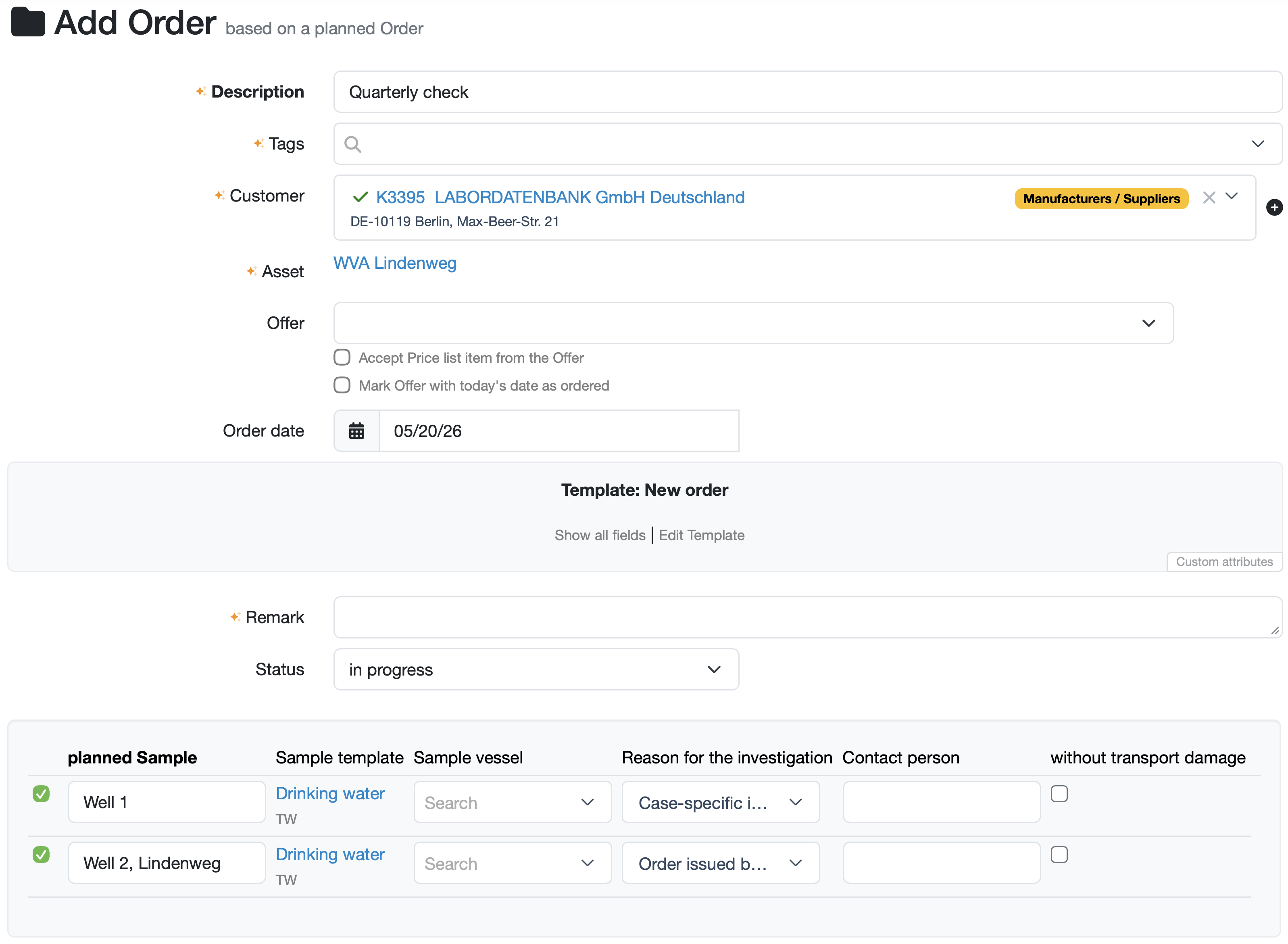
Figure: Activate planned order with samples

Rough and detailed planning

The order schedule can be seen as a rough plan – it shows when which samplings are due. Since samplings often require prior coordination (e.g. scheduling with the customer, availability of staff or ongoing production), detailed planning can be done when activating the order. When activating, a concrete sampling date with date and time can be entered – e.g. after a date has been agreed with the customer. The field for the sampling date can be configured on request by your customer support.


Use without the Objects module

The Planned Orders and Samples module can also be used via the order schedule without objects.
In that case, follow this path:
Navigation bar → Orders → Order schedule → + Add planned order


Add a single order to an object

In addition to order schedule, a single, non-scheduled order can also be created directly from an object – e.g. for a case-based sampling.

  • Open the desired object via the detail view.
  • Click + Add order in the top menu bar and select the desired order template.
  • The object is already linked to the order and visible in the order detail view.
  • Then add the samples to the order and assign each sample to the corresponding subasset.

Last change: 05/20/26

General information

Assets

Samples

Employees

PDF templates

Recipes

Reports

Report table editor

Interfaces

Kompetenzen

AI functions

Introductory phase

Query reports

Orders

Templates

Customers

Client zone (optional)

Offers

Invoices

Parameters

Calculating with parameters

Webservices

Transformationscode

Test plans / limit values / specifications

Documents control

Material

Questions and answers

Equipment

Trainings

8D-report

Others

Supplier evaluation

File management

Processes