Quality assurance for recipes: testing, evaluating, documenting

You can professionally test and document your recipes in the LDB. Measured values are automatically compared with specifications – regardless of whether you work in cosmetics, food production, chemistry, or another recipe-based field. You can keep track of all development stages, make data-driven decisions, and systematically improve your recipes – with automatic evaluations and calculations, error minimization, and immediate detection of quality problems.

The example implementation described below shows how you can achieve complete traceability and meet modern quality standards by linking recipes, projects, and samples—from development to testing.

Key advantages & concepts

Central data management

  • Each recipe is linked to a project.
  • The project collects all recipe-related data and links measured values, specifications, and clients/customers centrally.
  • All relevant information can be found in one place—from recipe development to final testing.
  • Complete transparency is possible for all project participants.

Data-based evaluation and optimization

  • We prepare your data for statistical evaluations and trend analyses.
  • Historical data is accessible and usable for continuous improvement.
  • Different recipe variants can be compared with each other.

Automatic quality comparison and quality assurance

  • Measured values and specifications are recorded via the samples (tests) and automatically compared.
  • Deviations are immediately apparent. The LDB immediately displays deviations (red) and confirms values (green).
  • Automatic target/actual comparison saves time and reduces errors.
  • Standardized testing processes can be applied to all recipes.
  • Comparability is ensured across time and variants.

Flexible variant management

  • Multiple recipes, recipe variants, and samples can be assigned to a project. You can develop and test multiple recipe variants in parallel.
  • Different formulations can be compared directly with each other—perfect for recipe development and optimization.
  • The optimal recipe can be identified quickly.
  • You maintain an overview of all development stages, can make informed, data-driven decisions, and systematically improve your recipes.

Traceable documentation and compliance

  • Complete traceability of all tests and results.
  • All changes are documented in the audit trail.
  • With structured data storage, you can easily meet compliance requirements, be ready for audits, certifications, and customer inquiries, and build trust.
  • The continuous documentation chain facilitates subsequent analyses.

Example implementation

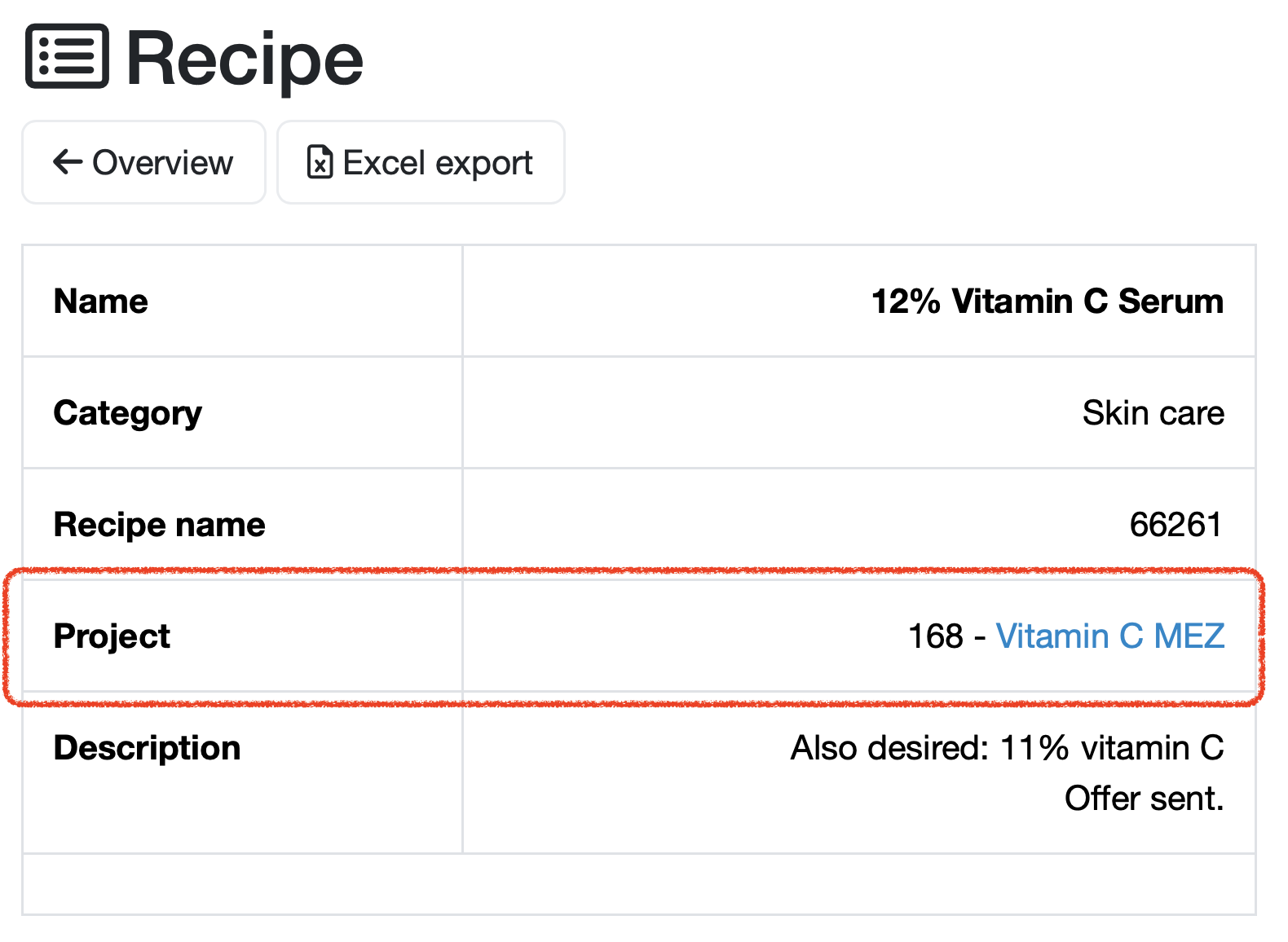
1. Create recipe and link project

When creating a new recipe or variant, the associated project is selected and linked to the recipe.
The linked project is displayed in the project field of the recipe form (e.g., 168 - Vitamin C MEZ).
Once linked, all project data are available.
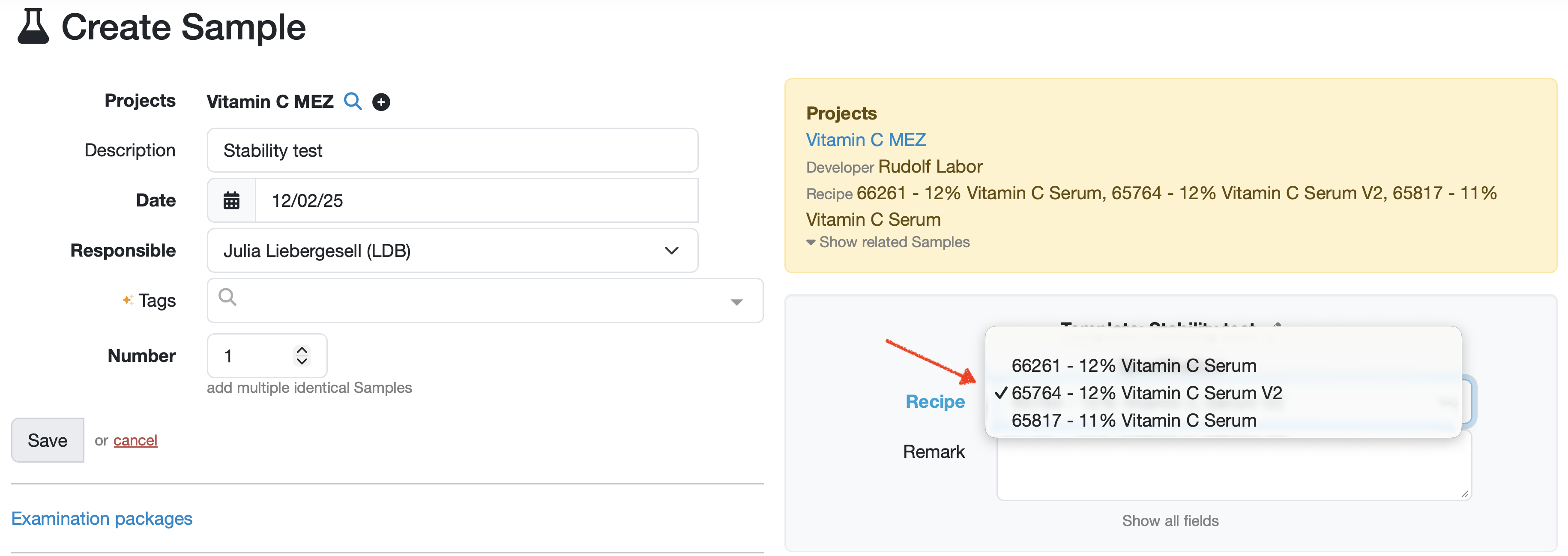
2. Create sample and assign recipe

To record measured values for the recipe, create a sample for the project.
Select the desired recipe using the selection field for the sample.
Select the desired recipe from the drop-down menu, e.g., 66261 - 12% Vitamin C Serum V2.
The recipe is then assigned to the sample and the sample is automatically linked to the project.
The project link ensures that only suitable recipes are available for selection, thus ruling out any confusion.
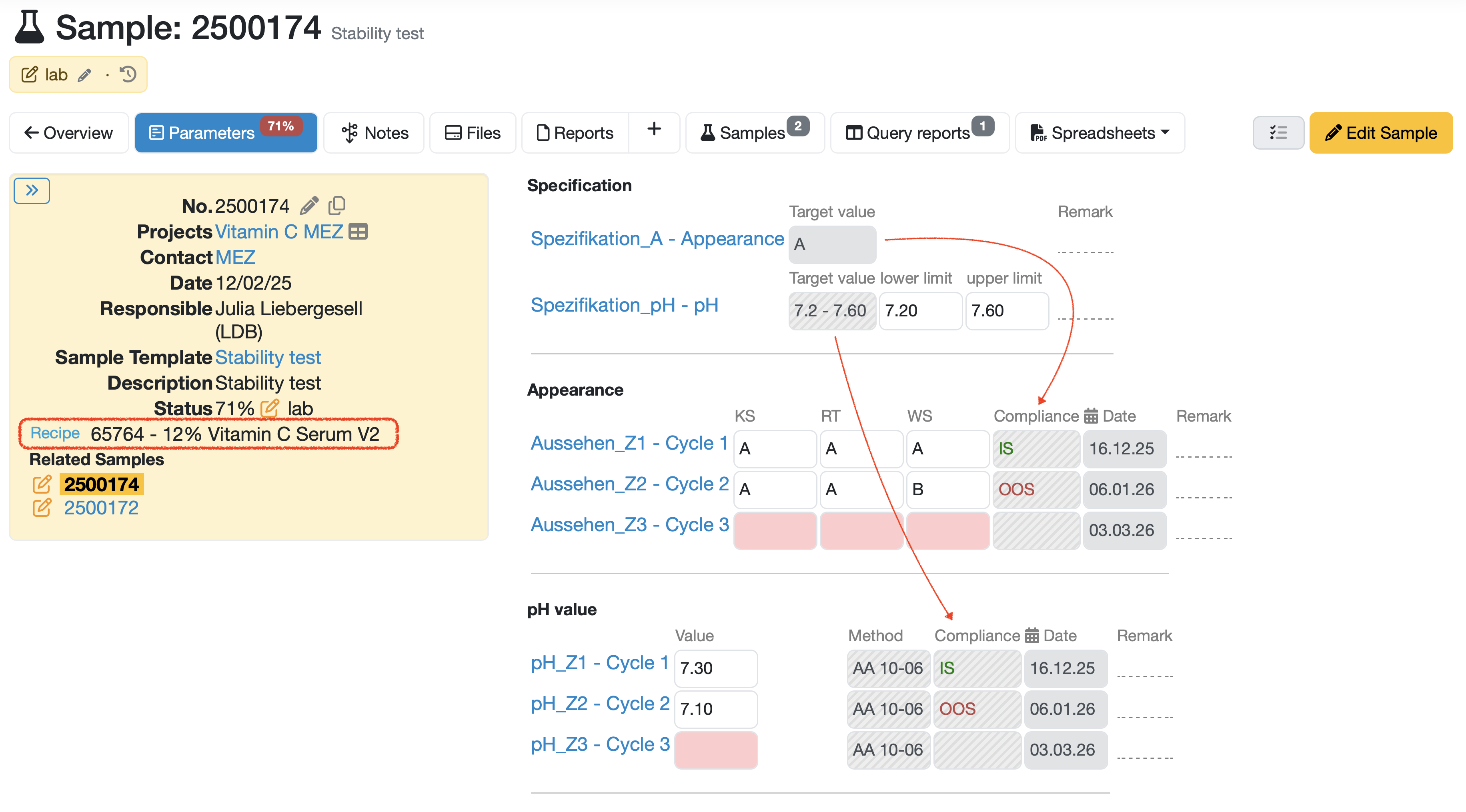
3. Record measured values and compare them with specifications

All measured values are now entered in the sample and automatically compared with the defined specifications.
Green markings indicate that the values are OK (within the specification).
Red markings indicate that deviations have been detected (outside the specification).
(This example uses one-time specifications that are recorded as parameters. For frequently used specifications, it is recommended to create them in the specification management or as a specification sample may be more advisable.)
All measured values for this test can be traced back to the respective recipe and are available for statistical evaluations, continuous improvements, and trend analyses.
Related topics: Manage recipes

Last change: 02.12.2025

General information

Reports

Report table editor

Interfaces

Kompetenzen

AI functions

Employees

Introductory phase

Query reports

Orders

Samples

Templates

Customers

Client zone (optional)

Assets

Offers

Invoices

Parameters

Calculating with parameters

Webservices

Transformationscode

Test plans / limit values / specifications

Documents control

Material

Questions and answers

Equipment

Trainings

8D-report

Others

PDF templates

Supplier evaluation

File management

Processes