Guide - Getting Started with the LDB
Video
In this onboarding video, you will get a compact introduction to the LDB. The workshop is a live recording and shows you step by step how to get started with the database. The content of the workshop is summarized below and expanded with selected topics.
Architecture, Database Model – Overview
How and where your data is stored
Our guiding principle: With the LDB, you collect and organize all data from your laboratory to make it accessible and usable anytime, anywhere.
Anywhere: All you need is a device with internet access.
Usable: Your data is stored in a structured, certified cloud. Extensive audits and data security policies protect your data from loss and unauthorized access.
Our data structure (simplified):
How order, sample, result and report are connected.
The central hub is the order – all associated data is collected and linked here:
- A customer hands you an order.
- One or more samples belong to the order.
- Each sample contains any number of measurement results.
- At the end there is a report (also: certificate or analysis certificate).
What else is there:
- A customer can have contacts.
- Samples and their measurement results can be linked to specification limits and specifications.
- Link measurement results with formulas.
- Query reports, import and export interfaces.
- The QM module.
- And much more.
All data is stored in structured tables, for having it available in a structured, usable and evaluable form.
So that you can find your workflows as easily as possible, the wording is customizable: For example, the order can be a product that is sampled regularly, and the sample can be a batch – depending on how you speak in your laboratory.
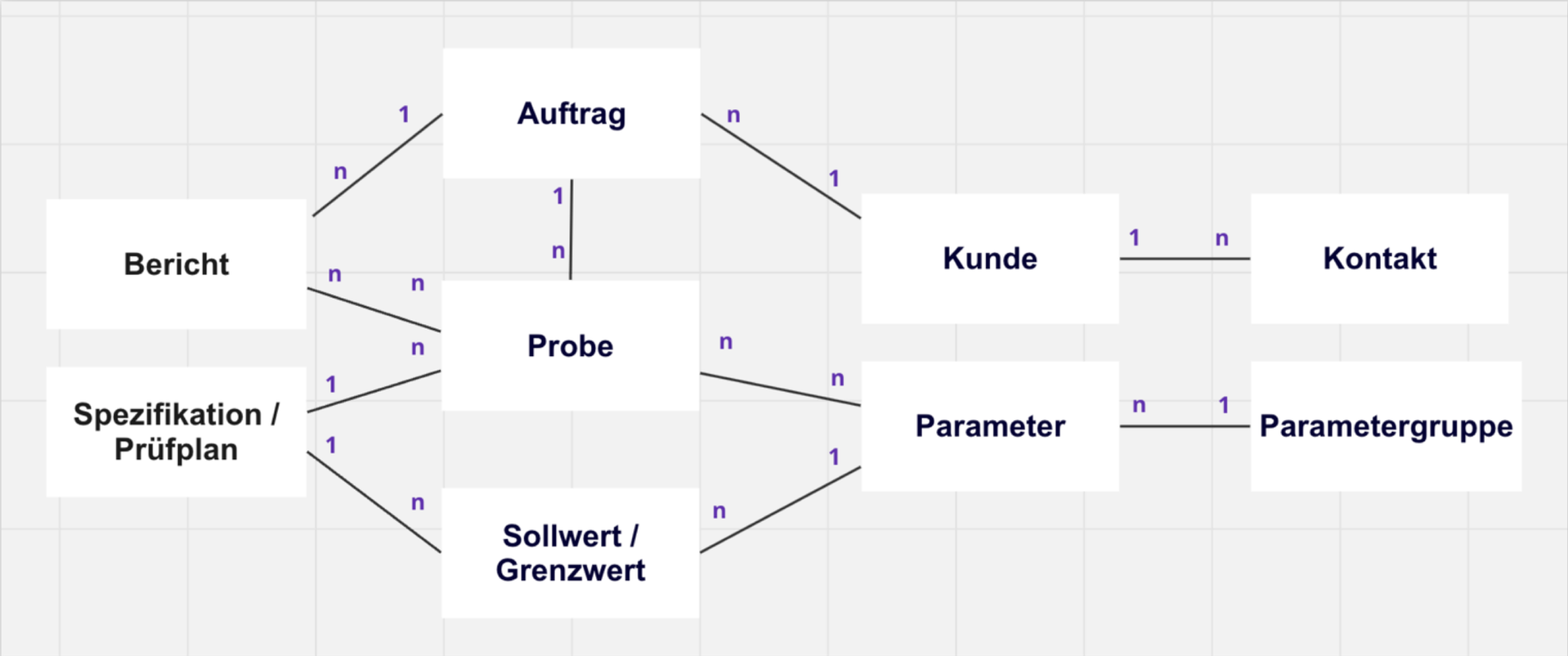
- A customer has
ncontacts andnorders (n = 0, 1 or more). - An order belongs to
onecustomer, hasnsamples andnreports. - A sample belongs to
oneorder, hasonespecification / test plan andnparameters. - A report belongs to
oneorder and hasnsamples. - A specification / test plan has
ntarget values, each applying tooneparameter. - A parameter appears in
nsamples, hasntarget values and belongs tooneparameter group. - A parameter group has
nparameters.
Figure: Data structure LDB
First Steps – Settings
Add Employees, Assign Logins and Define Security Settings
You can reach the login page at labordatenbank.com/demo. The initial password will be sent by e-mail.
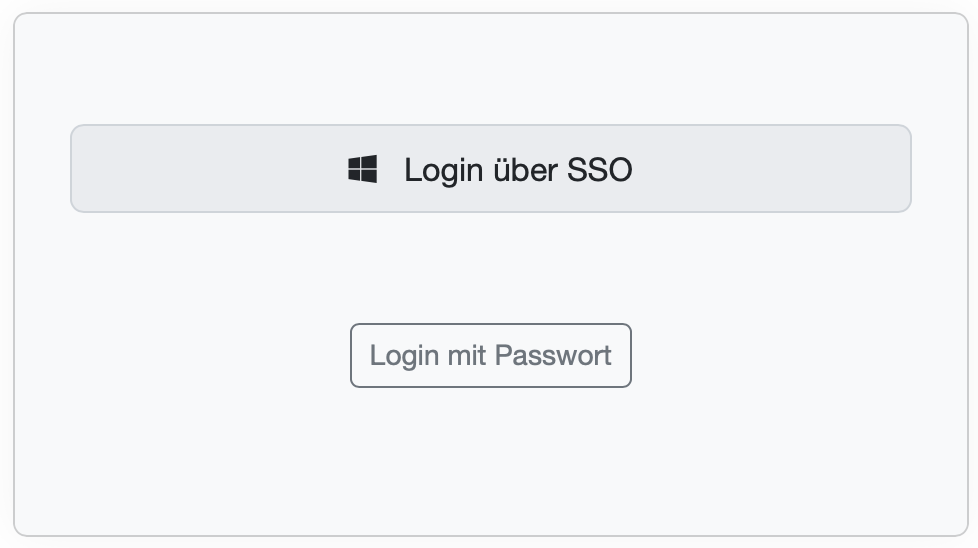
Figure: Login page LDB
Navigation
Follow this path: Navigation bar → Settings (gear icon) → Employees → green button Add user.
How to add an employee with an initial password
Enter the required fields (shown in bold) for each employee. These are Name, Short and Email.
Optionally, you can add further information such as profile picture, language, start page, etc.
The number of employees you can create depends on your license.
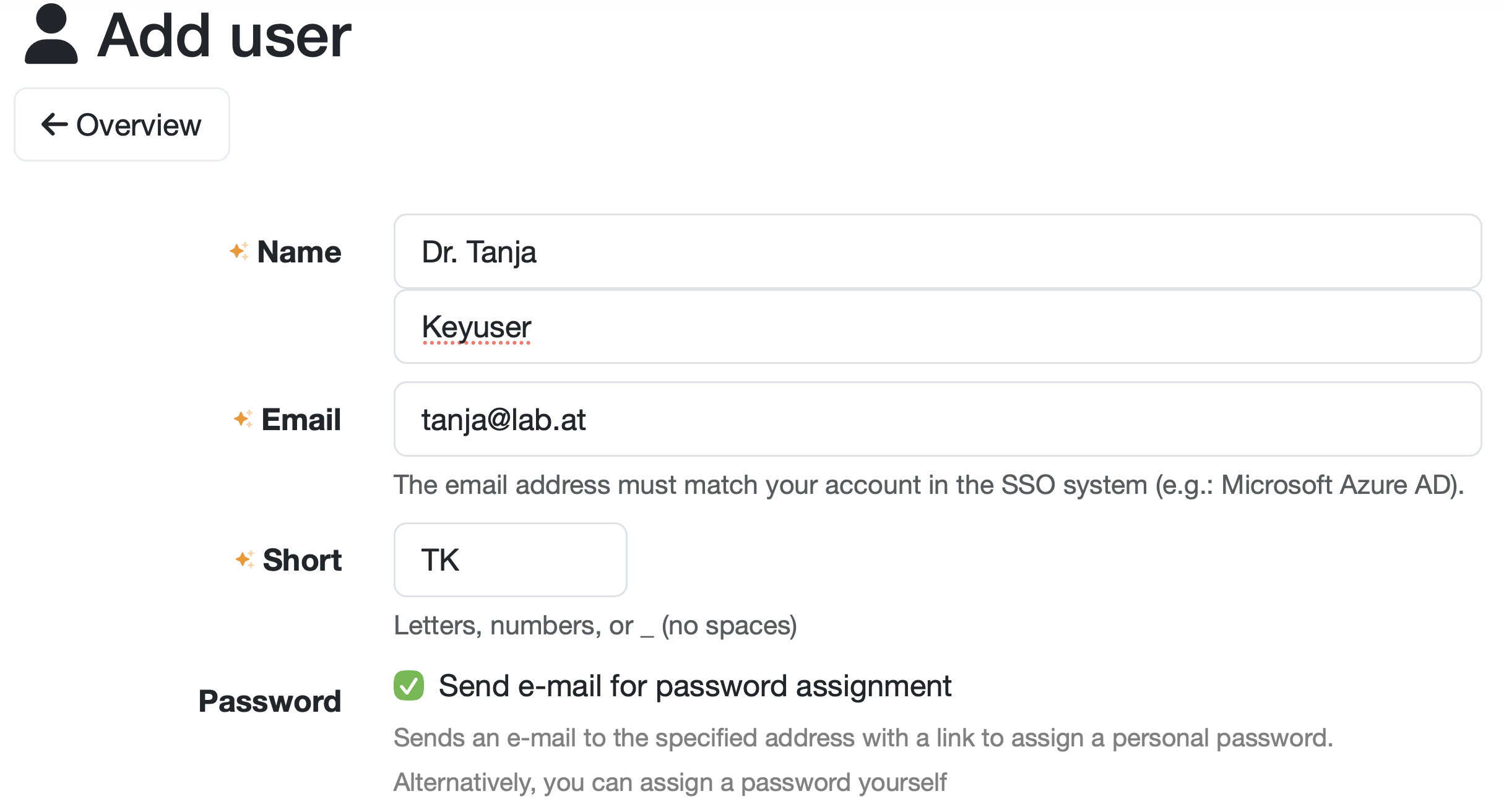
Figure: Add user
How does each employee receive their login credentials?
After saving the account, the employee automatically receives an e-mail at the stored address with a link to assign their personal password.
The link for password assignment is valid for 24 hours.
How is MFA set up to ensure secure access via authenticator app, security key or passkey?
The security of your data is of the utmost importance to us. We therefore offer modern, advanced security measures such as Multi-Factor Authentication (MFA). Using it is strongly recommended.
After the first login, the link Activate MFA as additional protection for this account is displayed in the top left.
Three methods are available for activating MFA:
- Activate TOTP (e.g. Google Authenticator): Scan QR code, time-based key is generated.
- Add security key: USB-stick-like device, plug in and tap.
- Add passkey: Fingerprint-based, stored in iCloud, Google Cloud or locally.
Important:
- Critical access rights (e.g. viewing the access rights matrix) are only visible and usable after an MFA-verified login.
- To set up MFA, each employee needs the access rights Change own password and Edit own data.
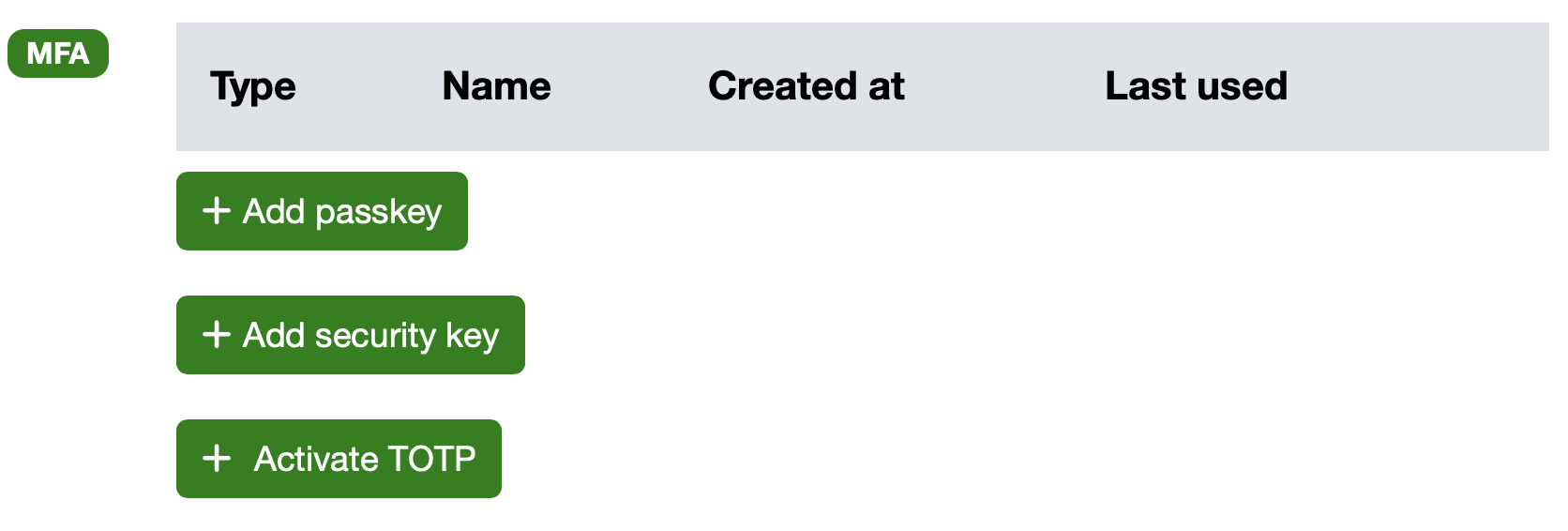
Figure: Activate MFA
Your to-dos for employee logins:
- Add employees
- Activate MFA for all users
Assign Access Rights
Navigation
Via Navigation bar → Settings (gear icon) → Manage Accessrights you access the access rights matrix and get an overview of all rights per module.
Structure employees, groups and roles sensibly, assign access rights (who is allowed to see, edit, delete what) and link competencies to access rights to build ISO 17025-compliant rights management.
Assigning access rights:
Rights can be granted or revoked individually by clicking on the circle symbol, or set across the board for all employees / groups.
Important: Set up at least two key users with full access rights so that password resets and rights assignments can be handled internally.
Particularly critical rights (marked in red) should be assigned deliberately, e.g.:
- View / edit access rights
- Delete samples
- View audit trail
Linking competencies:
Access rights can be linked to competencies. If an employee does not attend a mandatory annual training, for example, the corresponding access right is automatically revoked. Competencies can also be granted via the read confirmation of a document in document control.
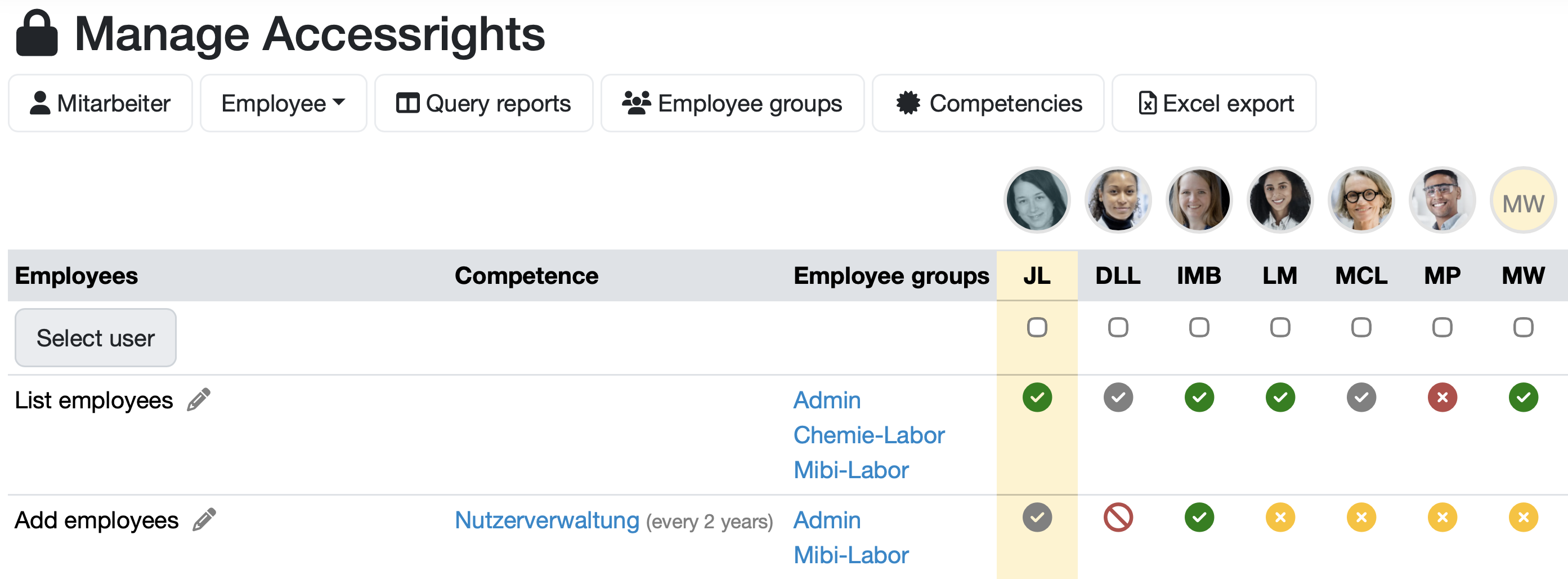
Figure: Manage Accessrights
Employee groups bring together employees with similar tasks and enable bundled rights assignment. Each group can additionally be restricted to specific sample areas (e.g. food, water, location A/B).
Your to-dos for access rights:
- Set up at least 2 admins with full access rights
- Review the access rights matrix and adapt it to your laboratory
Customize System Settings
Navigation
Via Navigation bar → Settings (gear icon) → System configurations you will find global configurations and information.
Here you can, among other things:
- Store rules for Authentication or configure SSO settings (e.g. restrict login to a specific authentication method: Users can only log in with MFA or SSO, or customize password rules)
- Customize logo & heading
- Store an SMTP mail server to send your e-mails (strongly recommended to avoid sending limits of the standard server)
- Module-specific settings, e.g. e-mail text for report dispatch, default due date for invoices ...
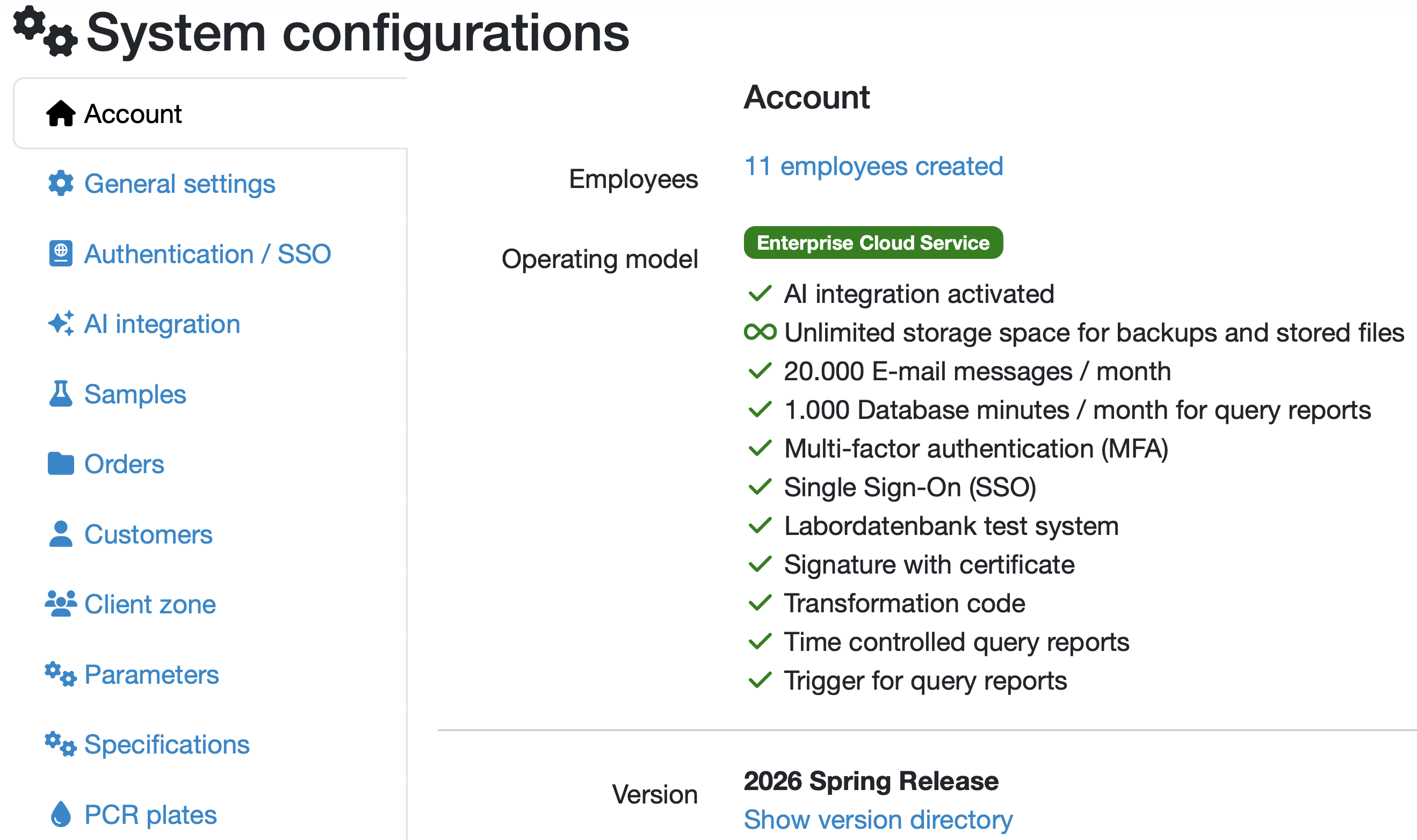
Figure: System configurations
Define Categories & Number Ranges
Categories enable the grouping of customers, parameters, test equipment and more – each with a name and color.
Navigation: You can find the categories for customers by clicking the grey pencil icon next to the Category dropdown when creating or editing a customer, parameter or test equipment.
Number ranges can be configured individually (e.g. continuing existing numbering systems, if not too complex, or starting from a specific number). Let us know your desired format.
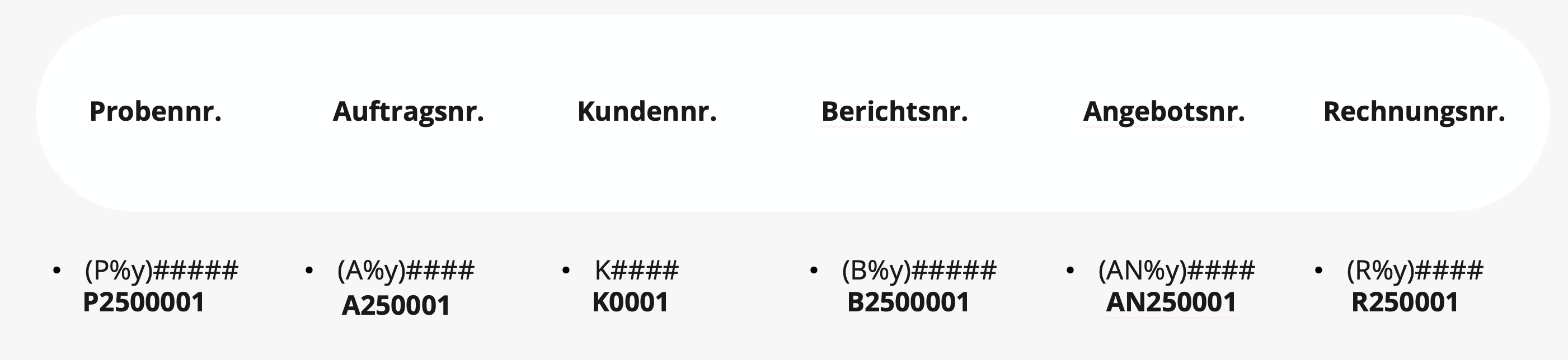
Figure: Example number ranges and syntax
Your to-dos for number ranges:
- Let us know your desired format.
Your to-dos for categories:
- Create the categories relevant to you in your LDB.
Define Master Data & Custom Fields
In every module (sample, order, customer, …) there are fixed required fields (bold) and optional fields where you can enter master data. In addition, individually configurable fields can be added: text fields, dropdowns, date fields, multi-select, checkboxes and much more. These can be grouped and highlighted in color.
Considerations for master data
- Which fields do we need in addition to the ones already available?
- What type should each of these fields be? (Text field, dropdown, date field, integers only, decimal numbers…)
- Are there required fields?
- Can I enter the necessary data at the parent module (e.g. order) for the subordinate data (e.g. samples), or do I need to enter them individually, e.g. per sample?
This consideration helps you determine whether to capture an entry at the order level as an order master data field – because it applies to all samples of that order – or at the sample level as a sample master data field, because entries can differ between samples within an order. - etc.
Your to-dos for master data:
- Coordinate and define master data fields per module with the team
- Send us the names of the fields you want to use per module and what field type (text field, date field …) they should have. We are happy to set these up for you in your LDB.
Create Parameters
Navigation
Via Navigation bar → Settings (gear icon) → Parameters new test groups, parameter groups and parameters can be created using the green buttons.
What are parameters and what are they used for?
Parameters are the individual measured variables and examination values recorded for a sample – for example pH value, Vitamin B12 or temperature. They form the basis for value entry, automatic calculations, report generation and billing in the database.
When creating a parameter, the name, abbreviation, unit, data type, columns for value entry and formulas are defined, among other things. Existing parameters can be edited.
Note: Depending on how many analyses you offer, creating parameters can be one of the more time-consuming steps. We therefore recommend planning a little more time for parameter management.
Once the parameters are in place, you can start implementing the dependent modules, e.g. reports, specifications and limits, import interfaces, etc.
- Parameters are organized in three hierarchy levels:
- Test groups are best oriented to disciplines or departments (e.g. Microbiology, Chemical Analysis).
- Parameter groups should bundle thematically closely related parameters – ideally 2–30 parameters per group (e.g. Vitamins, Physical Parameters).
- The order within each level can be adjusted by drag-and-drop and directly affects the sample view and reports.
- Up to 10 columns can be configured per parameter.
- Formulas allow values to be calculated automatically – for example averages, conversions or multi-step calculations.
Considerations for parameters
- Which do I need, which values are recorded?
- Parameter structure – how can I structure my current ones? Test groups, parameter groups, parameters?
- Are calculations performed? (What does Excel currently do?)
- What do I want to see as data/results in the parameters?
- How can I prevent a parameter from existing multiple times to avoid confusion and potentially higher maintenance effort? Can multiple columns be used for one parameter?
- How should results be entered (device interface, CSV import, manually)?
- etc.
Your to-dos for the parameter workshop:
- Watch the onboarding video
- Follow along and try it out
Your to-dos after the parameter workshop:
- Create parameters and add formulas where needed, then test
Video
Onboarding Workshop: Parameters
Customize Status Management
Navigation
You can find the status management under: Navigation bar → Settings → Manage status
The status management of the LDB allows you to map the processing state of individual records across many modules (e.g. samples, orders, customers).
Each status can be configured with icon, color, permissions and optional properties.
Each status can be optimally assigned one of the available properties, such as locked, finalized or hidden.
A status can be defined as the default and will then be automatically pre-selected for new entries. Using permissions, you can control who is allowed to set a specific status. As an enterprise feature, predecessor and successor conditions can be defined to enforce approval processes – e.g. that In Progress can only be followed by Reviewed and then only by Released.
Considerations for statuses
- Which statuses do I need?
- Which status is the default?
- Should optional properties (e.g. hidden) be linked to the status?
Your to-dos for status management:
- Configure and test statuses
Set Up the Template System
Navigation:
Via Navigation bar → Settings (gear icon) → Templates new templates can be created and existing ones edited.
What are templates and what are they used for?
Templates combine predefined entries with selected, configured master data and parameters. They reduce the data entry effort and are used on a recurring basis.
Create sample templates for specific sample types (e.g. food, water) and pre-select the relevant master data fields and parameters in those templates. This way, for a food sample e.g. the best before date automatically appears as a required field, but not for a water sample.
Templates can be arranged in a tree structure.
Both the template itself can be given a status (e.g. released or archived), and the data type created with it – e.g. the sample created from it – receives an initial status.
Templates can be created for various modules, including samples, orders and customers.
When creating a record, e.g. a sample, additional selections (master data fields, parameters) can be added if they deviate from the standard.
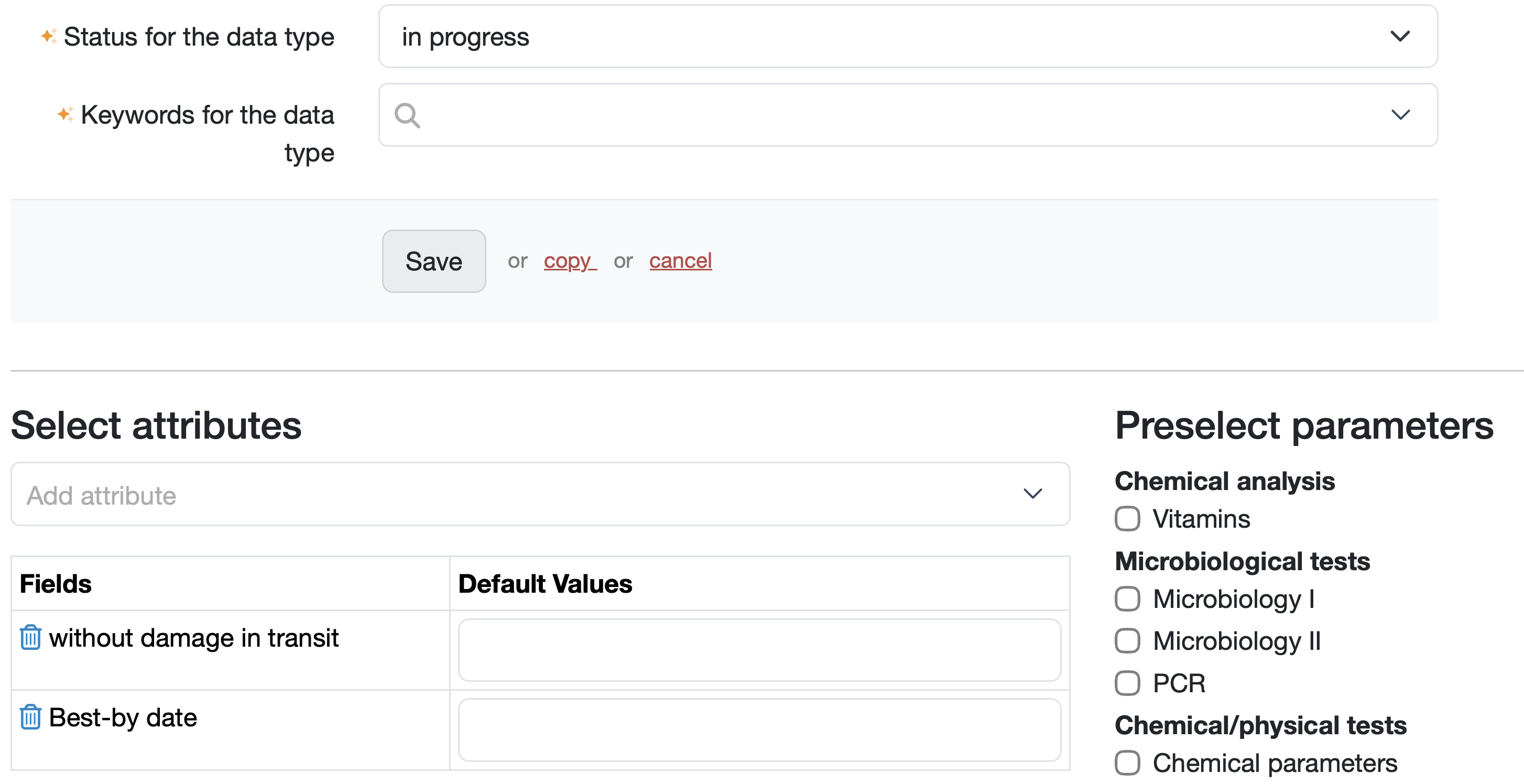
Figure: Create template
Considerations for templates
- For which modules are templates useful, increasing efficiency and clarity?
- Which pre-selections are sensible, necessary and can be used on a recurring basis?
- Keep in mind that too many templates can increase maintenance effort when something changes.
- Which fields / parameters should definitely be pre-selected, and which can optionally be added when creating a record?
- etc.
Your to-dos for templates:
- Create and test templates
- Let us know if any master data fields are still missing and complete the parameters in the parameter management if necessary.
Distribute Tasks
Notes & Markdown Pad:
In many places in the LDB (customers, samples, …) a markdown field is available for notes. There you can format text, mention employees (they will receive an e-mail notification) and link other data types. Notes can be commented on and are centrally viewable in the notice board.
Tasks:
In the task module, you distribute tasks with due dates, categories and responsible persons or groups. Recurring tasks are automatically recreated for the next cycle once completed.
Track Changes
Audit Trail:
Every change to data is recorded with the employee, time and content of the change. The audit trail is accessible both per record (e.g. directly on a sample) and globally via the system settings, and can be commented on – ideal for accreditation evidence.
Access to the audit trail requires its own access right, which can be linked to a corresponding competency (e.g. training Audit Trail & Data Protection).
Collaboration
Working successfully with us:
- Watch the onboarding videos
- Use the guides
- Try things out and test
- Submit a support request (e.g. via the button on the bottom right of every page) or use the notes function of the LDB
- Complete tasks before the next workshop
Onboarding Workshops
All workshops, modules and dates for a successful LDB introduction:
https://lims.eu/de/onboarding
Q&A
Can competencies be assigned to an entire employee group?
Currently, competency assignment is done manually per employee. However, automation is possible: either via a linked training or via the read confirmation of a document in document control.
Is there a dark mode?
Yes – via the employee abbreviation in the navigation bar at the top right → Dark color mode.
How does the restriction to sample areas work?
In the employee groups, you can define under Access to area which sample areas the group can see. Important: Once you use areas, all samples must be assigned to an area, otherwise unassigned samples will not be visible to anyone. Employees can be in multiple groups and thus gain access to multiple areas. This is also suitable for separating multiple laboratory locations within one system.
How do I set an individual start page?
Via the employee abbreviation in the navigation bar → Edit my account → select start page (e.g. dashboard, guide, sample list). The start page can be set individually for each employee to match their role.
Last change: 08/21/26
General information
- Main menu
- Dashboard
- Backup / Data protection
- Version number of the LDB
- Supported browsers
- Activation of SSO
- Print labels
- Automatic LDB validations
- Create/Edit/Delete Categories
- Status management
- SMTP Configuration
- Konfiguration SMTP via OAuth 2.0
- IT requirements for the use of the Labordatenbank
- Add Dashboard Widgets
- Deleted Records
- Onlineorder detailview
- Edit process key figures
- Create process key figures
- Manage 8D-Reports
- Process management view editing
- Edit processes
- Manage Projects
- Edit projects
- Edit planned order
- Edit planned samples
- Tag management
Supplier evaluation
- Evaluation criteria for suppliers
- Add/Edit Evaluation Criteria for Suppliers
- Edit evaluation criteria for suppliers
- Evaluate supplier assessment
- Add/Edit/Delete Supplier Evaluation
- Delete supplier evaluation
Material
- Manage materials
- Create/edit/delete material
- Linking materials with parameters
- Reorder Materials Online
- Management of chemicals
- Manage/Create/Edit/Delete Batches
- Use batch samples
Employees
- Manage employees
- Add/edit/archive employee
- Manage employee groups
- Edit employee group
- Create task
- Audit Trail: traceable documentation of all work
- Access rights
- Edit Accessright
- Time tracking - Create hours entry
- Time tracking - Hours per day
- Time tracking - Hours per week
- Time tracking - Annual overview
- Time tracking - Vacation days
- Time tracking - Manage Weekly Hours
- Labordatenbank Login / Logout
- Change password
- activate Multi-Factor-Authentification (MFA) with TOTP
- activate a Security Key for the MFA
- Activation of Passkey
- Install TOTP App
- Import employees (introduction phase)
Customers
- Manage customers
- Customer Detail View
- Create/edit/delete customer
- Merging duplicate customers
- Add / Edit / Delete contact persons at customers
- Outgoing Massages
- Detail view of an email
- E-mail templates for reports and invoices
- Forward emails to the LDB
- Import customers ( introduction phase)
Orders
- Manage orders
- Order Detail View
- Create/edit/delete Order
- Scanning and sending documents to the LDB with QR
- Order schedule
Samples
- Manage samples
- Add/Edit/Delete samples
- Enter values
- Results table
- Charts and Statistical Key Figures
- Manage Filters
- Edit - Search Filters and Column Filters
- Map pooled samples in LIMS
- Manage Stations
- Create / edit / delete station
- Book samples into a station
PDF templates
- Manage PDF Templates
- Create/edit PDF templates
- Create design elements
- Design elements Setting options
- Integrate report tables into PDF template
- Design element for the reason for reissuing test reports
- PDF template for sample labels
Assets
- Manage assets
- Add/edit/archive asset
- Add subassets to asset
- Add Planned Order and Sample
- Add tests to order templates
- Copy assets, order templates, and asset components
- Equipment GPS location
- Add on-site inspection
Recipes
- Manage recipes
- Create/edit recipe
- Recipe detail view and ingredients
- Quality assurance for recipes: testing, evaluating, documenting
Reports
- Manage reports
- Create/Edit/Archive report
- Request signature
- Sign reports
- Reissue of signed reports
- Send reports by e-mail or post
- Protect emails from spam filters
- Verify authenticity of reports and certificates
- Certificate
- Manage signatures
- Create / edit / delete a signature
Report table editor
- Create/edit/delete a report table
- Create / Edit reporttable column
- Creating a parameter table with target values
- Create sample table
- Create table with open structure
- Order of the report tables
- Fonts and character set for PDF reports
- Create checklist with report table editor
- Measurement repetitions value selection
Interfaces
- Import Interfaces Overview
- AI Extension for Import Interfaces
- Edit Attributes in Import Mapping
- Import results from measuring instruments
- Create CSV measurement data import interface
- Import measurement data
- Import of samples
- Mode for measured value import
- Automatic FTP/SFTP Import
- Test SFTP/FTP Connection
- Testing the HTTPS Import Interface
- Transformation code for importing other data formats
- Practical example: Import GC/MS measurement values to your LIMS system
- Practical example: Import Biomerieux Vitek antibiogram into LIMS
- Connect Thermo Fisher Chromeleon to LIMS
- Connect PCR to LIMS with plate assignment
- LIMS connection to DEMIS reporting for pathogen detection
- Tips for import interfaces
- Imort pictures in parameters
- Connection of Essentim data loggers
- SHAPTH - Drinking water database report transmission
Kompetenzen
AI functions
- Enable/disable AI integration
- AI Explorer
- Query Explorer
- AI Import: Automatically assign external calibration certificates
- Enable and Use Audit Assistant
Introductory phase
- Labordatenbank introduction checklist
- Labordatenbank data structure
- Implementing the QM-Database
- Import parameters (Introduction phase)
- Import sample master data (Introduction phase)
- Benefits of the LDB Cloud
- Configurable attribute fields in the LDB
- Transfer files securely to the LDB
Query reports
- Create query reports using a template
- SQL Basic Course
- SQL JOINs
- SQL Basics
- Create / Edit query reports
- Parameter columns
- Variables in query reports
- Export data from query reports
- Link Evaluations
- Query report tables (SQL table and SQL bar chart)
- Save and Display MySQL Backup Locally
- Link evaluations with import interface
Templates
- Create order templates
- Manage templates for samples
- Create/Edit/Add Sample template
- Templates for orders, customers, materials, and other data types
Client zone (optional)
- Customerzone
- Activating the Customer Zone
- Create Online Analysis Order
- Sampling with online analysis order
- Hide parameter columns in customer portal
- Provide files in the customer zone
Offers
- Create offer
- Add prices and price items
- Appendix with Terms and Conditions and Service Catalog
- Send Offer
Invoices
- Manage invoices
- Create Invoice
- Sending Invoices
- The English translation for "Teilzahlungen bei einer Rechnung erfassen
- Manage price list
- Exporting invoices
- Import billing items (Introduction phase)
- Create revenue centers for prices
- Activate X-invoice / E-invoice for Germany
- Create Collective Invoices
- Cancel invoice
- QR code for online banking on invoices
- Suggest billing items
Parameters
- Manage Parameters
- Parameter Detail View
- Add/Edit/Delete Parameter
- Create/edit/delete parameter group
- Daily Parameter List: What has to be done in the laboratory
- Parameter usage statistics
- Labeling of subcontracting and accreditation
- Parameter data types
- portray proficiency tests
- Manage examination packages
- Create/Edit examination packages
Calculating with parameters
- Deposit formulas with parameters
- Calculating with number sequences
- Calculation of dry matter and annealing loss
- Calculating with Date/Time Information
- Example: Weighing in and weighing out
- Example: Calculation of annealing loss with validity check
- Example: Determination of Chemical Oxygen Demand
- Example: Determination of TVC - aerobic mesophilic total viable count
- Bsp.: Drinkingwater-Legionella since March 2023 (German Regulation)
Webservices
- LDB Webservices
- Provide data as web services for external systems
- Send data to an external web service
- Send data to the Labordatenbank
- Example: Send eTermin to the LDB
- Example: JSON file for creating samples
Transformationscode
- General structure of a transformation code
- Transformation code for evaluations
- Export transformation code
- Webservice Response Handler
- Import transformation code
Test plans / limit values / specifications
- Create test plan / limit value table / specification
- Add specification limits / reference ranges
- Measurement value evaluation based on reference range values
- Detect and filter reference range deviations
- Parameter-specific text modules according to limit tables
Documents control
- Create a New Document
- Create new version
- Validate document
- Release Document
- Request read confirmation
- Import documents (Introduction phase)
- Change the document creator afterwards
- Delete documents
- Documents: Confirm validity check
Questions and answers
- IT requirements
- Where can I find the current version number of the _LABORDATENBANK__?
- How can I calculate the average from five measured values?
- How can I change the order of parameters in the packages?
- Querious: Delete archived reports
- Download files in the Edge browser instead of opening them directly
- Transfer the status of the production system to the test system
Equipment
- Test Equipment Management
- Test equipment detailed view
- Add/edit/delete Test Equipment
- Import test equipment (introduction phase)
- Create control charts
- Import control values from test equipment
- Print labels for test equipment
- Forward emails to test equipment
- Booking Test Equipment
- Test Equipment Calendar
Trainings
- TrainingSchedule: Document Training Sessions, Demonstrate Competencies
- Add/edit/delete training
- Import Trainings (Introduction phase)
8D-report
Others
File management
- Add Files (to Samples, Customers, Orders)
- Add Files (Test Equipment, Material, Batches, Specifications)
- File Management
- Search data
Processes