The Model Context Protocol (MCP) lets external AI applications access specific LDB functions that you have enabled. AI can then answer questions, retrieve current information, record structured data and carry out defined tasks.
Reports provide data from LDB. Import interfaces can send new data, tasks or status changes back to LDB.
/screenshots/stats_edit_140_interface_full_1280x1000/en/634ce00d9f8dc9d7.png)
What is MCP?
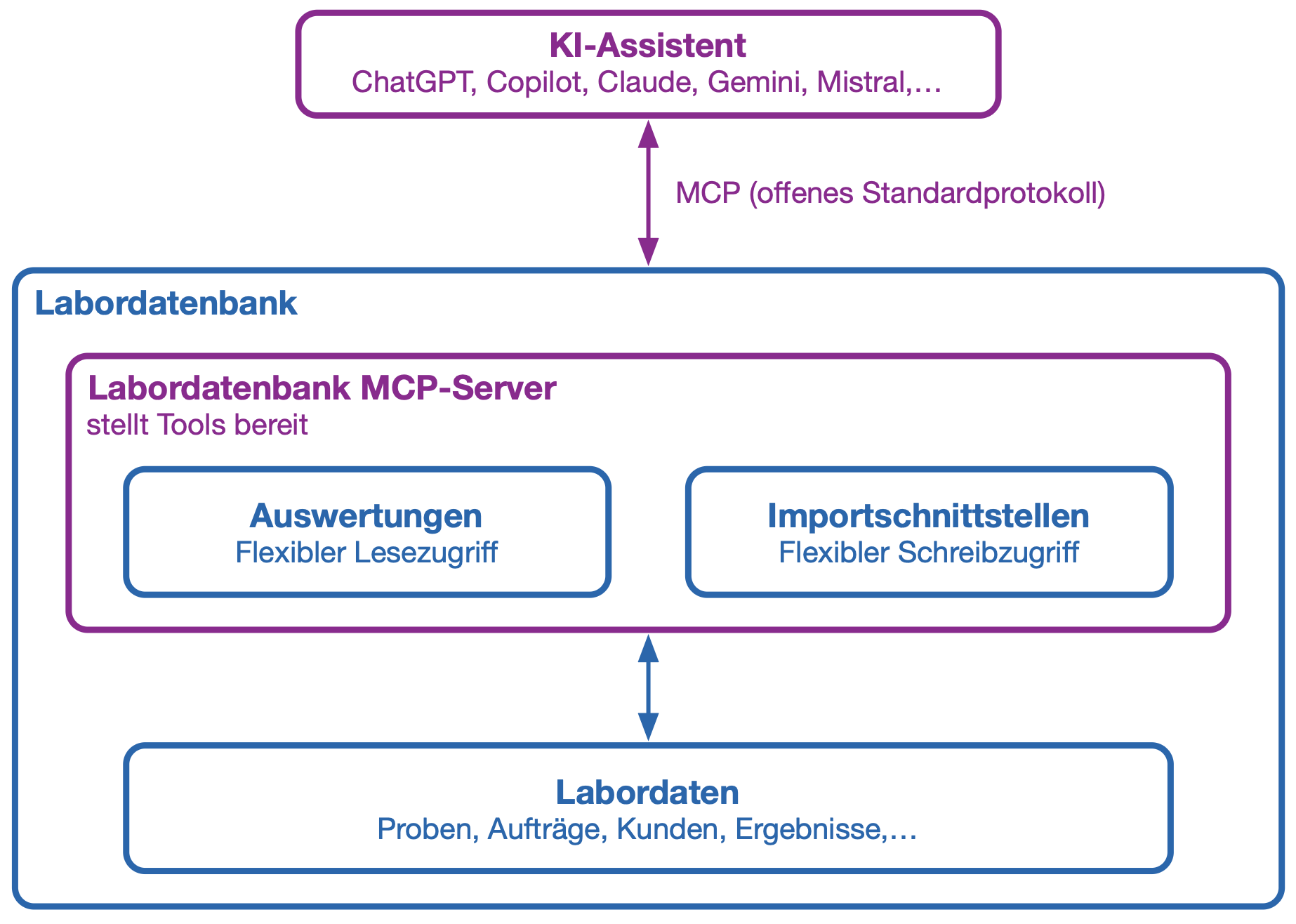
The Model Context Protocol, or MCP, is an open standard for connecting AI applications to external data sources and functions.
In simple terms, MCP is a shared language between an AI and LDB. The AI can identify which enabled tools are available, what information they require and how results are structured.
In LDB, reports can be provided as MCP tools for reading data, and import interfaces as MCP tools for writing data. The AI therefore works through clearly defined interfaces rather than direct, unrestricted database access.
MCP is not an AI model. It connects AI applications such as ChatGPT or Claude to the LDB functions and data you have enabled for that purpose.
During drinking water sampling, the sampling point, time, temperature, pH and other observations must be documented on site. Combined with an MCP-enabled AI voice application, this can be done hands-free.
For example, the sampler can dictate values through a suitably configured ChatGPT Voice Mode:
“Create a drinking water sample at the kitchen sampling point. Temperature 12.4 degrees, pH 7.3. No unusual odour or appearance.”
The AI structures the information and sends it to LDB through the enabled MCP import interface. LDB creates the sample and returns a status message with the sample number. The AI voice assistant reads out the status and number so that the sampler can label the bottle accordingly.
After sampling, the AI assistant can carry out further tasks:
The sampler can keep their attention on the sampling point and their hands free for the sampling itself.
MCP does not automatically give external AI access to all LDB data. Each report and import interface must be explicitly enabled for the user and for MCP use.
For sensitive actions or actions that write data, the AI agent should request confirmation before proceeding. This can be controlled through the associated MCP description.
See: General Data Security Guidelines (ADSR)Sebastian, Patrick and Konrad show you how to connect your AI assistant: